

Researchers demonstrate an all-perovskite 4-terminal tandem concept using spectral splitting
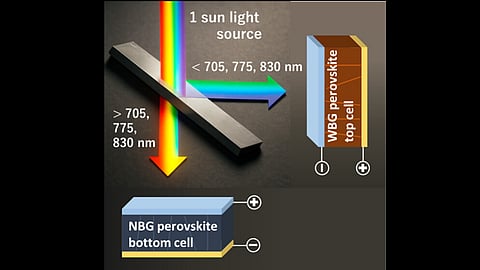
The approach uses a wide-bandgap FAPbI₃ top cell and a narrow-bandgap Sn-Pb bottom cell with optical light separation
The system achieves 30.2% efficiency under a spectral splitting setup, highlighting efficiency potential
Perovskite solar cell research is increasingly focused on tandem architectures to improve efficiency beyond the limits of single-junction cells. All-perovskite tandems are being explored for their tunable bandgaps and compatibility with various device designs. A recent study examines this using a 4-terminal (4T) configuration with spectral splitting and reports efficiencies above 30%.
In a study published in ACS Omega, researchers combine a wide-bandgap FAPbI₃ top cell with a narrow-bandgap Sn-Pb bottom cell using a spectral splitting approach. The top cell is based on FAPbI₃ films processed with nanoparticles. These improve film quality by increasing crystallinity and reducing recombination losses. The top cell achieves an efficiency of about 24.4%, with external quantum efficiency above 90% across much of the absorption range.
The bottom cell uses a Sn-Pb mixed perovskite, extending absorption into the near-infrared region. To address the instability of Sn-based materials, additives and interface treatments are used. These help limit oxidation and improve film quality. The bottom cell reaches efficiencies above 21%.
The device uses a spectral splitting setup based on a dichroic mirror. The mirror separates incoming light into shorter and longer wavelengths and directs them to the respective cells. Different split wavelengths were tested, with 775 nm giving the best result. At this point, both cells operate close to their respective limits. The combined system achieves a peak efficiency of 30.2%. The result shows improved use of the solar spectrum rather than gains from structural integration.
The setup relies on external optical components, and the 2 cells are not structurally integrated into a single device. This makes it different from conventional tandem modules. The results should therefore be seen as an assessment of efficiency potential rather than a deployable design. The study also evaluates a 2-terminal (2T) configuration under spectral splitting, reaching about 25.1% efficiency. This provides insight into current matching and bandgap selection for future tandem designs.
Overall, the work shows that both material quality and light distribution affect tandem performance. Improving the top cell and managing how light is shared between subcells remain important for further efficiency gains.
The detailed findings are reported in the study titled All-Perovskite Four-Terminal Spectral Splitting Solar Cells of 30% PCE with FAPbI₃ Wide-Bandgap Perovskite Fabricated by Nanoparticle Technology.
