
Key takeaways:
Jinchen offers 3 layup platforms, including a 2024 model that integrates layup and bussing in a single system
All models support modules with up to 12 strings and use automated pick-and-place systems with CCD-based inspection for string positioning
Cycle time and throughput vary across the models, with the integrated system completing layup and bussing in about 41 seconds per module
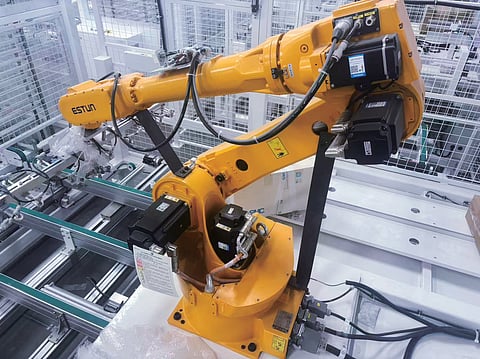
Jinchen has shared data for 3 models in the auto-layup section of the TaiyangNews Market Survey on Solar Module Production Equipment 2026. Of these, introduced in 2024, JC-PDYTJPB-DH is not only the latest of the lot but is also an integrated platform comprising layup and bussing systems as a pack. The other 2 – 2023-introduced JC-PBJ-LZ1V1-6000 and a 2018-introduced JCPBJ-HJ1V1-8000 – are just layup machines.
The latest models in the range, from 2024 and 2023, can lay up 12 strings per module, with each string containing 9 to 13 half-cells depending on the module format, whereas this information is missing for the 2018 model. However, the company has not specified the string length range for any of the models. All the models are compatible with the in-house stringer JC-CHYA10000 and can be made compatible with any third-party stringer. JC-PDYTJPB-DH and JC-PBJ-HJ1V1-8000 use a mechanical arm system, while JC-PBJ-LZ1V1-6000 uses a gantry robot system for picking and placing the strings and a conveyor belt for transport. These models support maximum module dimensions of 2,520 × 1,450 mm and edge auto-taping before the module goes to subsequent process steps. The entire range is provided with string and matrix inspection based on CCD. The string positioning accuracy, specified as ±0.3 mm for string-to-string and ±0.5 mm for string-to-glass, is also the same across all the listed models.
The primary distinction among the 3 models lies in their cycle time and throughput. With integrated layup and soldering, JC-PDYTJ-PB-DH completes a full cycle of laying up all 12 strings per module and performing bussing in about 41 seconds. The tool has a rated throughput of 1,040 strings per hour. JC-PBJ-HJ1V1-8000 has a relatively short cycle time of 36 seconds, performing layup at a rate of 1,270 strings per hour. The older JC-PBJ-LZ1V1-6000 model requires approximately 50 seconds to lay up all 12 strings of a module and reaches a throughput of 720 strings per hour. All stated throughputs correspond to a 12-cellper-string configuration. The system dimensions and weight of these models also differ: JC-PDYTJPB-DH measures 3,880 × 3,330 × 2,600 mm and weighs 5,000 kg; JC-PBJ-HJ1V1-8000 measures 3,960 × 3,840 × 2,300 mm and weighs 2,500 kg; and JC-PBJ-LZ1V1-6000 measures 3,450 × 3,780 × 2,300 mm and weighs 2,400 kg. When it comes to operational performance, Jinchen’s entire range listed here has a machine uptime of at least 99.5% and a claimed mechanical yield of 99.999% – the latter emphasizing nearly no breakages.

The text is an edited excerpt from TaiyangNews’ latest Market Survey on Solar Module Production Equipment 2026, which can be downloaded for free here.
