

DKEM says BC cells use less silver than TOPCon, as little as around 10 mg per full-size cell with zero-busbar designs.
ISC Konstanz says BC leads TOPCon on cell and module efficiency and expects it to become mainstream from 2028.
LONGi's Hi-MO 9 Prime reaches a 98.58% active area and up to 680 W with zero cell spacing and rear busbars.
AIKO's ABC 4.0 lifts cell efficiency to 27.4% and active area to 97%, for 500 W in a 1762 × 1134 mm format.
JA Solar's finger interconnection cuts silver use while adding more than 10 W of module power.
TCL Solar's C3 module delivers 675 W, with a roadmap to 700 W by 2029.
Dual-sided contacting technologies – TOPCon, which dominates today's production, and HJT – are still improving, but each further efficiency gain is getting harder to achieve. Day 1 of the TaiyangNews High-Efficiency Solar Technologies 2026 conference looked at how far these technologies can still go. That raises an obvious question – where will the next gain come from? Day 2, on November 20, was devoted to one of the strongest answers – moving all the contacts to the rear of the cell – back contact, or BC, technology.
The idea is not new. Back contact cells have existed for decades, mostly as a premium niche product. "What's new is scale," noted Shravan Chunduri, Head of Technology at TaiyangNews, in his opening remarks. A few manufacturers are already producing BC at gigawatt level, and several others are evaluating it. BC also leads in commercial module efficiency. It has held the top spot in the TaiyangNews TOP SOLAR MODULES efficiency ranking ever since the listing was launched in January 2022, when Maxeon led at 22.7%. In the latest edition, AIKO and LONGi share the top spot at 25%.
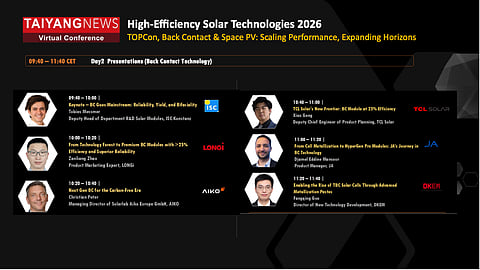
The conference brought together a research institute, leading manufacturers and a materials supplier. Tobias Messmer of ISC Konstanz compared BC with TOPCon on efficiency, cost and reliability. LONGi, AIKO, JA Solar and TCL Solar presented their BC cell and module platforms, and DKEM explained how metallization pastes are being adapted for TBC cells. In the closing panel, moderated by Chunduri, AIKO's Christian Peter and Messmer discussed what could accelerate BC adoption.
ISC Konstanz – Bifacial BC is entering utility scale
Tobias Messmer, Deputy Head of Solar Modules at ISC Konstanz, sets the scene by comparing BC with LECO-processed TOPCon. ISC has long favored BC and developed its industrial BC cell concept, ZEBRA, which it brought into production with SPIC in 2019. Messmer notes that BC leads in efficiency with 26% compared with 25.5% for TOPCon at the cell level, and 25% and 24% at the module level, following the same order. TOPCon retains an edge in bifaciality, at 80% compared with about 76% for BC, but Messmer says bifaciality has little effect on yield. The key differentiator is cost – BC's cell cost of ownership is 25% higher, at 5.0 ct/W compared with 4.0 ct/W for TOPCon. However, BC is expected to win over the long term in LCOE potential, falling below 1 ct/kWh, while TOPCon's potential lies below 1.5 ct/kWh.
The bulk of the benefits are attributed to the cell architecture. BC naturally exhibits soft reverse breakdown, keeping its cells cooler under reverse bias. Copper metallization is easier to apply on the rear, and the absence of front contacts allows inter-cell spacing to be reduced or eliminated. Citing a 2026 study by T. Liu, Messmer showed that a BC module lost 12.9% of its power when one cell was fully shaded, compared with 33.9% for TOPCon; however, this advantage diminishes as more cells are shaded. Regarding reliability, TÜV Rheinland data presented at the TaiyangNews Reliable PV Module Design Conference 2026 showed no meaningful differences among BC, TOPCon, and HJT in either TC200 or PID.
Messmer considers the ITRPV forecast of around 30% BC share by 2036 to be on the conservative side, citing the UNSW projection at WCPEC-9, which shows BC taking a rapidly growing share of production by 2029. In ISC's view, cost reductions from standardized processes and multi-GW production have enabled bifacial BC to enter the utility-scale market. One example is the 68 MW plant in Bosnia and Herzegovina, which went live in 2025 with trackers and bifacial AIKO modules. ISC expects BC to become the dominant technology for terrestrial PV from 2028.
LONGi – Closing the gaps at module level
Zanliang Zhao, Product Marketing Expert at LONGi, took the company's 28.29% world record for a single-junction crystalline silicon HIBC cell as the lead of his presentation. He described the achievement as just one step below the theoretical ceiling, with further gains expected at the module level. Building on its HPBC 2.0 cell, the company is relying on 3 technologies – zero cell spacing, hidden busbars, and Selective Temperature Alloy Connection (STAC).
BC cells have a primary advantage of no front gridlines, which in conventional cells shade 3.92% of the light-receiving area. LONGi overlaps the cells to eliminate the gaps between them, adding about 1% of active module area. Another optimization in this ‘area’ is to move the module busbars to the rear. This helps in gaining an additional 1.1%. In total, the company says its modules have nearly 6% more effective light-receiving area than conventional ones. Because BC also inherently enables interconnection only at the rear, the ribbons run straight through the overlap without folding, which LONGi says cuts mechanical stress by 56% compared with standard overlapping designs. STAC holds the ribbons in place with a localized fixing material and establishes interconnection at low temperature during lamination, reducing thermal stress by 53%, according to Zhao. This also reduces the risk of microcracks and finger breakage, according to LONGi.
All these advanced approaches are nicely packed into Hi-MO 9 Prime series, which has an active area of 98.58%. The module reaches up to 680 W and 25.2% efficiency. This results in a rated power of 665 W in mass production, compared with 650 W for mainstream products of the same size, according to LONGi. This translates into 2.3% more capacity in the same installation area. The module also passed reliability tests such as DML, UV, and TC200, within the company's internal limit of 2% degradation, against the 5% allowed under IEC.
AIKO – ABC 4.0 reaches 97% active area
Christian Peter, Managing Director of AIKO Europe, has put some numbers on BC's scale-up. AIKO has shipped 200 GW of cells and modules in total and cumulative deliveries of its ABC modules have gone from 0.5 GW in 2023 to 14.7 GW in 2025 with over 26 GW expected by the end of 2026. Europe is a major market. Annual distributed generation deliveries in Europe have gone from 1.8 GW in 2024 to 4.1 GW in 2025, and AIKO expects to ship 8.3 GW in 2026.
ABC 4.0 takes cell efficiency from 27.2% to 27.4% with six process improvements, including poly-Si layer improvement, improved hydrogenation, tunnel oxide engineering and front surface texturing. At the module level, the zero-gap layout, AIKO's InvisiRibbon interconnection, and optimized string spacing push the active area to 97%, compared to about 96% for the previous generation and is far higher than the mainstream TOPCon modules at 92%, according to Peter. This results in a power rating of 500 W for a module in the 1762 x 1134 mm format, compared with 485 W for ABC 3.0 and 470 W for a TOPCon module of the same size. The cells have a tunneling diode structure, which gives them a soft reverse breakdown; in AIKO's tests, hot-spot temperatures remained around 100°C, compared with 170 to 175°C for BC modules without this protection.
A key highlight of Peter’s presentation was the company's Z Series G4 module, offered with an exceptional 40-year product warranty, longer than the product warranties of mainstream commercial modules. The next developments on AIKO’s roadmap are ultra-thin and multi-busbar designs, multi-cut shingling, hybrid passivation and stacked grids, with a 700 W module targeted for 2029.
JA – Finger interconnection cuts silver use
JA is developing TOPCon and BC in parallel rather than choosing between them, said Djamel Eddine Mansour, the company’s Product Manager. The company has been working on BC since 2016 and started mass production in 2026. The Hycium BC cell has achieved a TÜV Rheinland-certified efficiency of 28.38%. At the moment, JA is offering the BC technology under HyperGen Pro module series for rooftop applications.
Mansour mainly focused on the interconnection technologies JA developed in his presentation. After conventional BC and zero-busbar designs, JA Solar has moved to a new approach of finger interconnection, a truly busbar-less design. Here, the fingers and ribbons run in the same direction rather than crossing. In addition to reducing silver consumption, the approach also shortens the current path, resulting in more than 10 W of extra power, according to Mansour. The process uses flat ribbons, which increases the contact area, improves connection reliability, and distributes stress over a larger area. The process still relies on silver-based metallization, and Mansour underscores that JA Solar's objective is to use less silver rather than replace it.
The zero-gap layout delivers a 0.4% performance improvement, and moving the module busbars to the rear increases the light-receiving area by 1.4%. For the uniform black appearance, the dual-glass monofacial module uses a two-color rear encapsulant – black facing the front for all-black aesthetics and white on the inside for better reflection. In comparison to its TOPCon modules JA Solar has reduced the annual degradation from 0.4% to 0.35% and improved the temperature coefficient to -0.26%/°C. The module series is offered in different variants to suit different application scenarios. For example, a 2.8 mm front glass is offered for hail-prone regions. For areas near airports and highways, the company offers acid-etched front glass with anti-glare properties that reduce glare by up to 95% and increase yield by 1.9%, and by up to 8.5% in low light.
TCL Solar – Optimizing BC from wafer to module
Xiao Gang, Deputy Chief Engineer of Product Planning at TCL Solar, tracks the BC history of the company back to SunPower, which was the very first company to commercialize the BC technology. SunPower's BC technology passed to Maxeon, which is now majority-owned by TCL, and its business outside the US operates as TCL SunPower International. Xiao gave an overview of the company's patent portfolio, consisting of 1,600 active BC patents spread across key markets worldwide. TCL Solar, with its undeniable leadership in wafer supply, has developed special wafers for BC. These lightly doped wafers achieve a minority carrier lifetime of up to 10,000 µs, which is estimated to gain module power by 3 W. At the cell level, the TCL solar cells follow a unique approach: photolithography for patterning, the most critical step in BC processing, instead of the mainstream practice of laser ablation. This enables higher doping and boosts the cell efficiency by 0.1%, according to Xiao.
The new C3 module will achieve a screen-to-body ratio exceeding 95%. Other key features include half-cut shingled cells that eliminate spacing within each string and a 3 mm reduction in creepage distance with butyl edge sealant, each adding about 1% to the active area. The special interconnection process, performed at 140°C, reduces stress. The module is rated with a bifaciality of 80%. It also features a light-conversion film that converts UV to visible light, which helps keep degradation below 2% after UV120 and below 3% after UV240. TCL states that the C3 will deliver 675 W, 1.8% more output than conventional BC under working conditions and 1.3% more energy in a side-by-side field test in Haikou, China.
Xiao presented the company’s product roadmap, with C2 reaching 660 W by the first half of 2027 and C3 taking over in the second half of the year at 675 W. The company then plans to reach 685 W in 2028 with ultra-thin and multi-busbars, along with high-density patterning. In 2029, the goal is to reach 700 W with shingled design and optimized hybrid passivation. TCL is also offering application-specific modules for desert, offshore, and high-wind sites, as well as for areas with hail above 35 mm.
DKEM – BC already uses less silver than TOPCon
BC cells already use a lot less silver than TOPCon, according to Fangqing Guo from leading metallization paste vendor DKEM. A full-size TOPCon cell uses around 60 to 70 mg of silver, whereas a BC cell can be well below 50 mg. With zero-busbar designs, silver consumption in BC cells can be as low as around 10 mg per full-size cell, according to Guo. He further explained that part of the advantage is the 0BB design and that BC also performs well with less silver. The fill factor is much less sensitive to reduced silver laydown than TOPCon, which does see a significant drop in fill factor below 50 mg of paste. In the customer designs that DKEM tested, module power was unaffected even with the substantial amount of silver cut at the cell level.
Getting there is all about paste design. The TBC crux of contact formation in BC cells is that contacts on both the n-type and p-type polysilicon are fired at the same temperature, and without laser-enhanced firing, the paste has to deal with the contact barrier on its own. The p-poly contact is the tougher one and requires higher glass content and more aggressive etching. With thinner polysilicon and higher doping, the risk of over-etching is greater. Firing is less than 40 seconds and the light injection that follows helps the silver crystallites form the contacts. If the light-injection temperature is too high, the crystallites will grow too large, leading to increased contact resistance and reduced Voc. DKEM therefore tunes the etch strength and the glass frit composition to each customer's poly-Si process. Fine-line printing is the most straightforward way to use less silver, but stencil openings below 7 µm make it very difficult to print, so silver particle size and glass frit size must be balanced against good contact.
Pure copper is the next step. Guo says pure copper paste is already in volume production for BC cells at LONGi, and customers are moving straight to pure copper rather than silver-coated copper. The design still has the two silver seed layers to form the contact, with copper as the conductive layer. Copper diffusion is still the main issue and whilst some of the customers' products have passed IEC reliability testing, more rigorous testing is still going on.
Panel – Yield, cost and standards will set the pace
In the final panel, Chunduri started with “what still holds BC back?” Christian Peter from AIKO said he doesn't see any particular impediment, as BC's market share is rising sharply. The technology is of course not easy to manufacture and patents have been an obstacle for the technology. "Yield is the most underrated thing in the industry," he said, "it's the biggest cost driver." Silver is next. AIKO still uses some silver in conjunction with copper plating and is in the process of moving completely to copper. The cost of ownership of the lasers is not a significant factor according to Peter.
Messmer is convinced that utility-scale PV will go with BC modules. Asked by Chunduri what has halved the BC cost premium over TOPCon, from 1 ct/W to 0.5 ct/W, he points to lower manufacturing operating costs from wet chemistry and water usage, and reduced silver via the 0BB designs. In his view, the biggest lever specific to BC is gap doping, which can be tuned for shading, hot-spot, and UV. DKEM's figure of around 10 mg of silver per BC cell, he admits, did surprise him.
For utility developers, the decision comes down to price, and AIKO assesses each project on LCOE, partial shading, and temperature behavior. BC bifaciality was once a weakness but is now at 85%. Peter stressed that front-side efficiency is more important than bifaciality. Both panelists called for clearer testing procedures. Peter referred to the issue of capacitance and light soaking when testing BC modules and mentioned a round-robin test where AIKO sent eight modules to different labs. Messmer said that any change to the metallization, interconnection, or encapsulation would require new reliability data and that standardized busbar layouts would be of benefit to module manufacturers.
Day 3 of the conference, on November 25, looked beyond Earth, with a focus on space PV. Our summary of the final day will follow.