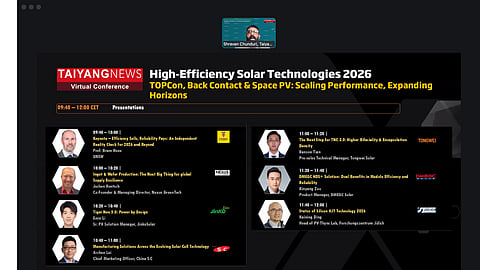


UNSW outlined pathways to reduce silver consumption in TOPCon cells to below 2 mg/W through silver-lean screen printing, while also highlighting the technology’s UV-induced degradation risks
Nexus GreenTech presented a European consortium for ingot and wafer manufacturing amid China’s move to restrict equipment exports
JinkoSolar presented its latest technology platform with high efficiency for premium residential applications
China S.C’s new vertical LPCVD reactor for TOPCon needs comes with a promise of high throughput and low footprint
Tongwei and DMEGC Solar use butyl rubber edge sealing to fit more cell area into their modules, with DMEGC also presenting new frames
Forschungszentrum Jülich says overcapacity has slowed HJT, though its low-temperature process suits tandem cells
Efficiency remains the most powerful lever in the solar industry. Every gain in cell efficiency means more power from the same wafer, bill of materials (BOM), and factory space. In other words, it reduces resource consumption across the supply and value chain per watt – the solar industry’s critical metric.
With module prices under intense pressure, higher efficiency has also become a clear differentiator. The topic has been discussed in TaiyangNews publications and at in-person and online conferences covering a range of subjects.
The TaiyangNews annual flagship online conference series, High Efficiency Solar Technologies, was initially organized to place special emphasis on technological and efficiency developments. Over time, the conference theme has also evolved to reflect prevailing market conditions.
This year’s edition, TaiyangNews High Efficiency Solar Technologies 2026, spans three days, each with its own focus. Day 1 of the online conference, on November 11, focused on dual-sided contacting technologies, with TOPCon as the industry mainstream and HJT alongside it. On Friday, November 20, we turn to back-contact technology, which is emerging as the strongest challenger, with a few manufacturers already producing at gigawatt scale. This year, the conference takes a step further and looks beyond Earth. Space PV has attracted enormous attention recently, driven by the rapid growth of satellite constellations and the need for lower-cost solar power in orbit. On Wednesday, November 25, we provide an overview of space PV.
UNSW – TOPCon Reliability, UV Testing and Silver
In his keynote, Prof. Bram Hoex from UNSW Sydney, emphasized that TOPCon will remain the leading cell technology architecture for the next 10 years. Discussing reliability in TOPCon, he underscored that TOPCon is still sensitive to UV-induced degradation (UVID), and with poly-finger designs, this now applies to the rear side as well.
UNSW has developed a UV-B accelerated test that shows UVID sensitivity within days. Research showed that ALD AlOx stacks displayed better UV stability than PECVD stacks. Increasing AlOx thickness from 4 nm to 7 nm improves UV stability further. Hoex also emphasized gaps in the testing protocal – the time between exposure and measurement and the IEC spec for UV dose. At 15 kWh, it is too low, equal to about 50 days of exposure in Sydney, while the worst locations get around 200 kWh of UV a year, according to Hoex.
On the topic of silver, Hoex said screen printing is here to stay because it is a mature process, and silver-lean methods using seed layers can bring consumption below 2 mg/W. UNSW has also made a TOPCon cell with 23.5% efficiency with pure copper printing, and mini-modules showed no major problems in accelerated tests. The polysilicon layer acts as a barrier for copper, which makes copper an option for the rear side.
Nexus GreenTech – Ingot and Wafer Production Outside China
Jochen Rentsch, Co-Founder and Managing Director of Nexus GreenTech, spoke about equipment solutions for upstream ingot and wafer production. Providing an overview of the global ingot and wafer production landscape, he emphasized that China accounts for almost 100% of global ingot and wafer output. In addition, most of the equipment and spare parts used in these factories also originate from China. Outside China, operating capacity remains very small, although around 150 GW of new capacity has been announced in India, the US, and the Middle East.
This dependence is now becoming a risk. China is discussing export controls on manufacturing equipment, so projects outside China may struggle to get the tools they need. Rentsch said this opens the door for other equipment suppliers to return to the ingot and wafer business.
Cost is another hurdle. According to Rentsch, ingot and wafer production is more expensive outside China mainly because of labor, but greater automation can offset it. Factory layout also plays a role, as wire saws take up almost half of the production floor and about 40% of materials can be recycled within the plant. To meet these needs, Nexus GreenTech leads a German consortium that offers complete ingot and wafer factories, with PVA TePla for ingot production and ARNOLD for brick processing. Its DataSphere PV software covers manufacturing execution and data analysis for fully automated production.
JinkoSolar – TOPCon for Utility and TAC for Premium Rooftops
Enzo Li, Senior PV Solution Manager at JinkoSolar, presented the Tiger Neo 3.0 series for utility-scale projects. The module series uses quarter-cut cells, offers 650 W to 670 W of power, and reaches 24.8% module efficiency, with 85±5% bifaciality. For residential rooftops, the company has launched the all-black Tiger Neo 5.0, rated at up to 510 W and 25.52% efficiency.
Tiger Neo 5.0 is based on JinkoSolar’s TOPCon-based Amorphous-Si Passivating Cell (TAC) technology, which uses heterojunction contacts in the p-type region and TOPCon contacts in the n-type region. Li said Multi-Cut Passivation (MCP) 2.0, Full-Spectrum Light Trapping (FLT), and Uniform Matrix Interconnection (UMI) have the potential to improve efficiency further.
China S.C – Turnkey Lines, Thin Wafers and Vertical LPCVD
Archon Lai, Chief Marketing Officer of China S.C, focused on the company’s new vertical LPCVD reactor, used to deposit the polysilicon layer in TOPCon cells. According to Lai, the vertical design cuts the equipment footprint by 32.9%. The tool comes in two versions. One is designed to fit existing factories with limited cleanroom height, while the other is a full-size reactor with higher capacity.
China S.C says it holds over 70% of the global market for mainstream TOPCon equipment and more than 90% of TOPCon turnkey lines based on PECVD, although its share of LPCVD lines is lower. It also supplies turnkey lines for PERC and HJT, and says it is the only official supplier of RPD equipment for TCO deposition. Lai added that TBC is drawing more inquiries than expected as its cost gap with TOPCon narrows. The company is also developing 50 to 60 µm wafers for space applications, and its pilot line has produced ultra-thin HJT cells with 25.5% efficiency.
Tongwei – Higher Bifaciality and More Active Area
Ranson Tian, Pre-sales Technical Manager at Tongwei, said the next steps for the company’s TNC TOPCon technology are a bifacial factor above 90% and higher packing density. Tongwei’s latest TNC 3.0 technology platform combines quarter-cut cells, adjusted front Al₂O₃ and SiNx layers, ultra-fine stencil-printed fingers, and TPE technology to repair edge damage from cutting.
To raise bifaciality, Tongwei keeps the rear polysilicon layer only under the metal fingers instead of across the whole rear side, improving bifaciality from about 80% to 85%. Adding rear-side texturing and a three-layer SiNx/SiOxNy/SiOx stack pushes it to about 90%, with a maximum of 93.07%.
For higher packing density, Tongwei uses butyl rubber edge sealing, so larger cells can sit closer to the frame. This increases cell density by 2.98% for G12R and 3.06% for G12N modules. According to Tongwei, butyl rubber blocks water vapor and oxygen far better than POE or EPE, and modules using it stayed within 3% power loss in its reliability tests, including DH2000 and PID. Tian presented the company’s roadmap for TNC 3.0 G12R modules as 650 to 655 W in Q4 2026, rising to 660 W in 2027. In R&D, Tongwei has reached 682.8 W at 25.28% with a 66-cell G12R module and 802.43 W at 25.83% with a G12 module.
DMEGC Solar – HDS+ Edge Sealing for More Power and Reliability
A key attribute of the HDS+ series from DMEGC is also improved module active area. Kinyang Zou, Product Manager at DMEGC Solar, said module makers are trying to increase the area that receives light on both sides, for example, by removing gaps between cells, overlapping cells, and reducing the creepage distance at the module edge. IEC 61730-2:2023 allows a creepage distance shorter than the usual 10.4 mm when a cemented joint is used. In return, modules have to pass tougher qualification tests, including thermal cycling, insulation resistance, wet leakage, and volume resistivity.
DMEGC’s patented HDS+ (High Density Secure Plus) technology uses butyl rubber for this joint. The material lets little gas or moisture through and has a higher volume resistivity than EVA or EPE. According to DMEGC, HDS+ adds around 9 W of module power, works at system voltages of 1.5 kV and 2 kV, and showed lower power loss in 3,000-hour damp heat tests. The company says it started mass production of HDS+ last year.
Zou also presented two new frame options. A high-strength steel frame with an S-shaped profile that reduces rear-side shading by 76%. This improves the bifaciality by about 2.8%. It also passed mechanical loads of +6,000 Pa/-3,000 Pa. The other variant is a fiberglass-reinforced polyurethane frame. It expands at the same rate as glass, does not corrode, and has about a quarter of aluminum’s carbon footprint.
Forschungszentrum Jülich – HJT Under Pressure but Still Relevant
The conference also featured a high-level overview of the developments in the HJT sector from Kaining Ding, Head of PV-Thync lab at Forschungszentrum Jülich. He emphasized that overcapacity and competition from TOPCon and back-contact cells have slowed HJT expansion. To lower costs, HJT makers are using silver-coated copper paste and zero-busbar interconnection. Another cost-saving potential for HJT, according to Ding, is that a vertical hot-wire CVD setup could double throughput compared with PECVD. However, development has slowed because commercial demand is low.
HJT, with its inherent advantage of a low-temperature process, works well as the bottom cell in perovskite-silicon tandems. Ding pointed out that TOPCon is catching up here as well, citing LONGi’s certified 35.5% tandem cell and JinkoSolar’s 34.82% perovskite-TOPCon tandem. He also presented a study on UVID. Cells with more transparent passivating contacts lost 9.34 percentage points of efficiency after UV exposure, compared with 2.58 points for standard HJT contacts. He suggested UV down-shifting encapsulants that convert UV into light the cell can use to reduce these losses.
Panel – Surprises, Achievements, and Outlook for TOPCon and HJT
The closing panel was moderated by Shravan Chunduri. Both Hoex and Ding said TOPCon’s progress over the past five years had surprised them. Hoex did not expect TOPCon’s open-circuit voltage to come so close to HJT without poly-fingers on the front, and called LECO a game changer. Ding said the large production volumes paid for the learning curve. Asked which lab developments have made it into production, Hoex named contact patterning and Ding the silver-coated copper paste.
On how much more the technologies can improve, Hoex said TOPCon still has room in current and fill factor. For HJT, Ding said the main problem is parasitic absorption, and a UV-resistant passivation could be a breakthrough. On whether high silver prices could help HJT, Ding said TOPCon keeps moving, which makes it hard for an alternative to catch up. Hoex added that copper and nickel are promising options for TOPCon. Ding also said manufacturers are now more hesitant to add another process step for a small efficiency gain. He sees TBC as already commercial and HIBC as the long-term goal.
In conclusion, the panelists agreed that TOPCon can still improve, but much of the discussion focused on contact stability, UV testing, and silver rather than efficiency alone. At the module level, edge sealing and new interconnection designs are adding power, and several companies are now working on back-contact cells.
Indeed, back-contact technology is the topic of Day 2 of the High-Efficiency Solar Technologies Conference 2026 on November 20. Day 3, on November 25, will cover space PV. Registration is free and can be done here.