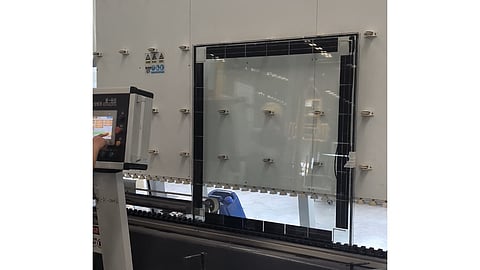


ClearVue says its Gen3 Vision Glass can receive soft Low-E coatings after solar PV cell lamination, describing it as an industry-first capability
The process was validated on AGC Interpane's standard production line without requiring changes to existing coating equipment
The capability could expand the use of BIPV glazing in commercial façades by meeting common thermal performance requirements
ClearVue Technologies has announced what it describes as a ‘manufacturing breakthrough’ for its Gen3 Solar Vision Glass, enabling soft low-emissivity (Low-E) coatings to be applied after solar PV cells have been laminated.
The company said the new capability could expand access to the commercial façade market for its building-integrated photovoltaic (BIPV) glazing.
Gen3 Vision Glass is ClearVue's latest BIPV glazing product, integrating the company's patented solar technology into insulated glass. It says the product is compatible with standard curtain wall and framing systems.
Announcing the latest update, the Australian BIPV technology company said its laminated glass can now undergo a standard magnetron sputter coating process after lamination. This enables soft Low-E coatings to be applied on surface 4 of the glazing unit, which it said provides greater solar heat control than the surface 5 position typically used in other BIPV products.
According to ClearVue, the capability allows its energy-generating glazing to meet the thermal performance requirements commonly specified for commercial façades while continuing to generate electricity.
“These coatings are specified on most commercial façades worldwide. ClearVue's energy generating glazing now meets that requirement. This opens the door to a significantly wider set of commercial projects,” it explains.
ClearVue said its Gen3 Vision Glass units were successfully processed on AGC Interpane's production line in Plattling, Germany, without changes to the standard coating process. The units were coated on the same production line and under the same operating settings as conventional float glass.
The result, it adds, demonstrates that its laminated solar PV glass can be processed on existing industrial coating lines without specialized equipment. This could lower manufacturing barriers and support broader adoption of BIPV glazing in commercial buildings.
“We can place a high-performance soft Low-E coating on surface 4... exactly where it delivers the greatest solar heat control,” said ClearVue CEO and Managing Director Doug Hunt. “It means our customers get the thermal performance a commercial building is designed around and clean energy from the same glass.”
The announcement follows recent certification milestones for Gen 3 Vision Glass, including IECEE CB, CE, and TÜV MARK certifications, following independent testing and certification by TÜV SÜD. It also announced its metal-backed solar panels, developed with manufacturing partner Helios Power, meeting IEC 61730 (2023) and IEC 61215 (2021) standards (see Asia Pacific Solar PV News Snippets).
Last month, the company announced the appointment of BIPV expert Prof. Rebecca Yang to its board as an independent non-executive director to support ClearVue’s strategy of commercializing advanced BIPV technologies globally.
Speaking of technology, TaiyangNews will look at the latest developments across the PV manufacturing ecosystem – from production tools to material innovations on August 25, 2026 at its Cell & Module Production Equipment and Processing Materials Conference. Registrations are free here.
