

BC manufacturers are optimizing the cell layout to improve the light absorption and increase the bifaciality of up to 80±5%
The BC manufacturing process is built on TOPCon with improvements in poly-finger structure
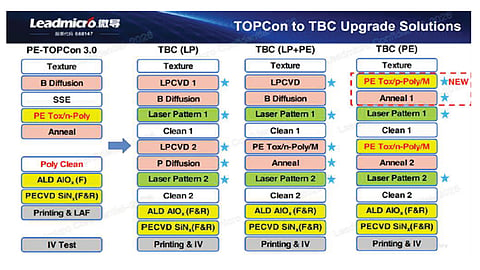
The new equipment solutions enable BC production using both LPCVD and PECVD, affording the manufacturers flexibility when upgrading TOPCon production lines
A notable trend in BC technology is its transition toward bifaciality, an attribute that was, until recently, considered off-limits for BC. With both positive and negative contacts located on the rear side, BC cells were traditionally viewed as monofacial by design, with limited scope for rear-side light harvesting. However, this perception is rapidly changing as manufacturers increasingly position BC for utility-scale applications, where bifacial gain is a key driver of system value. In response, BC developers have made significant optimizations to the cell layout to open up the rear side for light absorption. A few approaches in this direction were also highlighted by AIKO’s Senior Product Solution Manager, Guillermo Estébanez. These include reduced finger width, adjustments to n- and p-region electrode spacing, reduced n-poly thickness, evolution from MBB to SMBB and now to 0BB interconnection structures, and partial rear-side texturization. All these have helped BC reach bifaciality levels of up to 80±5%, narrowing the gap to TOPCon (see Copper-Based Metallization In BC Cells).
From an equipment perspective, BC builds on TOPCon technology and aligns even more closely with the latest poly-finger advanced structure. Using standard TOPCon as a reference, BC – especially TBC, based on the TOPCon route of passivated contacts – introduces a few extra steps. The main difference lies in adapting the passivated contacts for both polarities, whereas TOPCon applies this structure only to the rear side for n-type polarity. After depositing polysilicon and diffusing dopants for both polarities, laser patterning creates a distinctive interdigitated structure, which is also additional.
Traditionally, LPCVD has been the go-to method for polysilicon deposition in BC, echoing the early days of TOPCon when LPCVD was also favored. This exclusivity has limited the scalability of PECVD-based TOPCon technology for BC. To address this, Leadmicro developed a hybrid approach that combines PECVD and LPCVD: LPCVD handles poly deposition before boron diffusion, while PECVD is used for n-poly deposition. After years of dedicated research, Leadmicro now offers a PECVD solution for both p- and n-type regions. This breakthrough means that the technology choice made at the TOPCon stage no longer restricts future scaling to BC; BC is now fully compatible with both LPCVD and PECVD.
