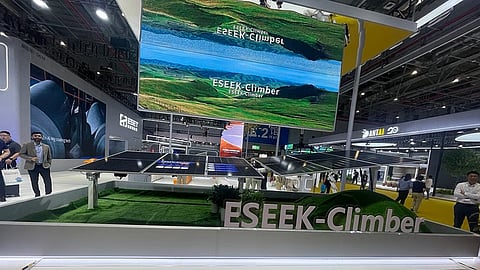


ESET Solar presented tracker platforms covering independent-row 1P, dual-linked 1P, and 2P configurations
The flagship ESEEK-Anchor tracker supports long-row utility-scale installations with tracker lengths exceeding 180 m
The portfolio includes solutions optimized for vibration control, linked-row layouts, large-format module configurations, and hilly terrain
China-based solar tracker manufacturer ESET Solar showcased its utility-scale solar tracker portfolio at SNEC 2026. The company's display included the ESEEK-Anchor, ESEEK-Steady, ESEEK-Twins, ESEEK-Climber, and EXCEED tracker platforms. Together, the portfolio covers independent-row 1P, dual-linked 1P, and 2P configurations designed for different project layouts, terrain conditions, and site requirements.
ESET Solar presented ESEEK-Anchor as its flagship tracker platform. The horizontal single-axis tracker supports up to 6 strings per row and tracker lengths exceeding 180 m. The design incorporates a self-balancing architecture and slew-drive tracking mechanism intended to support long tracker rows in utility-scale installations. The tracker supports up to 180 modules per tracking system, offers a tracking range of ±60°, and is compatible with both 1,000 V and 1,500 V PV systems.
For independent-row applications, ESET highlighted the ESEEK-Steady tracker. Supporting up to 4 strings and tracker lengths of up to 145 m, the system incorporates a diamond-shaped torque tube together with an axisymmetric damper and an all-points self-locking mechanism. The company said these features are intended to improve structural rigidity, reduce vibration under high-wind conditions, and maintain more uniform torque distribution across the tracker row. The tracker offers a tracking range of ±60° and is designed for sites with north-south slopes of up to 20%.
ESET also showcased the ESEEK-Climber tracker, an independent-row 1P system developed for hilly and mountainous terrain. The tracker incorporates a slope-following structural design that allows the main beam to adapt to changes in elevation and uneven landscapes. ESET said the design is intended to reduce terrain-related constraints while simplifying installation in challenging sites. The system offers a tracking range of ±60°, supports terrain slopes of up to 15%, and is designed for wind speeds of up to 70 m/s. The company also highlighted a self-locking architecture and intelligent control functions intended to support operation and maintenance.
The ESEEK-Twins platform targets projects requiring linked-row tracker layouts. The dual-linked 1P configuration supports 2 rows with up to 2 strings per row and tracker lengths of up to 72 m. The system uses a rotating transmission shaft and a simplified linkage design intended to facilitate installation and accommodate construction tolerances. ESET specifies installation tolerances of up to 15° in both horizontal and vertical directions. The tracker provides an alternative layout option for utility-scale installations beyond conventional independent-row designs.
The company's portfolio also includes the EXCEED tracker platform. The 2P tracker uses a multi-point drive architecture and supports up to 6 strings with tracker lengths of up to 110 m. The design targets utility-scale installations utilizing 2-in-portrait configurations and complements ESET's 1P tracker offerings for projects with different layouts and site requirements.
Across the portfolio, ESET highlighted several common design features, including self-locking mechanisms intended to provide more uniform torque distribution, vibration-control systems designed to improve stability during high-wind events, and installation-focused structural concepts aimed at simplifying deployment across different site conditions.
ESET Solar is part of the Metavast Group and supplies PV mounting systems and EPC solutions. The company reports cumulative tracker shipments exceeding 40 GW, with projects deployed across more than 50 countries and regions worldwide.
