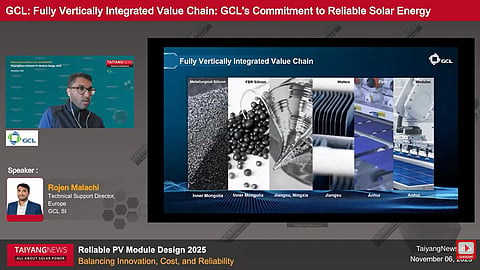


GCL positions full vertical integration from metallurgical silicon to finished modules as central to long-term reliability and quality control
The company highlighted FBR granular silicon, UV degradation control, and extended IEC testing to limit early-life and long-term degradation
Updates on back-contact, TOPCon, and perovskite tandem modules point to GCL’s focus on both near-term reliability and future efficiency gains
Developments in cell architectures and manufacturing processes are placing new reliability demands on PV modules. Long-term control of degradation and mechanical stress is now a growing focus of the industry. During the TaiyangNews PV Module Reliability conference, Rojen Malachi, Technical Director for Europe at GCL SI, discussed how material selection, process control, and extended reliability testing are being used to support stable performance and predictable energy yield.
In his presentation titled, Fully Vertically Integrated Value Chain: GCL’s Commitment to Reliable Solar Energy, Malachi said that PV module reliability defines the success of solar assets, particularly as investors place greater emphasis on degradation behavior and first-year yield. He explained that GCL’s strategy is built around full vertical integration, allowing the company to control quality and consistency from the silicon atom level through to finished modules.
This vertical integration begins with metallurgical silicon production and extends through FBR granular polysilicon, ingot growth, wafer manufacturing, cell processing, and module assembly. Malachi stated that GCL is one of the few companies operating across the full value chain, allowing closer control over material purity, wafer defect density, and cell passivation quality.
He highlighted that the use of fluidized bed reactor (FBR) based granular silicon offers both reliability and sustainability advantages over conventional Siemens-process polysilicon. The material is used across GCL’s cell production, with impurity levels kept below 0.5 parts per billion. GCL also pointed to a significantly lower carbon footprint for its FBR silicon, citing third-party-verified emissions of 14.4 kg CO₂-equivalent per kg of polysilicon.
Traceability was also discussed as another pillar of GCL’s reliability approach. Malachi said GCL maintains batch-level tracking across silicon, wafers, cells, and modules, covering production lines and test data. He added that the system has been audited by TÜV Rheinland and is implemented at the product level through QR codes on the SIRO module series, with data stored using blockchain-based records.
Turning to performance, GCL addressed early-life degradation with a focus on UV-induced degradation (UVID). According to the laboratory data presented, GCL modules showed a UVID-60 degradation of around 1.2% under the test conditions, while some comparable products reached degradation levels of up to around 5%. UVID-60 is an accelerated UV test used to measure early-life degradation behavior.
GCL presented IEC 61215 mechanical reliability test data for its bifacial dual-glass modules, including damp heat, thermal cycling, and UV exposure, as well as additional testing beyond standard IEC requirements. Reported degradation remained below the 5% IEC limit.
Malachi also addressed reliability considerations related to GCL’s back-contact (GPC) module architecture. According to the presentation, low-temperature soldering, linear busbar layouts, and current-flow design choices are used to improve shade tolerance, mitigate hotspot formation, and limit micro-crack propagation. These features were discussed as being particularly relevant for rooftop and other partially shaded applications.
GCL also outlined reliability-related updates to its TOPCon platforms, including the use of 3-cut and 4-cut cells and a busbar count of 26, aimed at lowering operating current and mechanical stress. On perovskite technology, the company said its 2 m² single-junction perovskite module has received third-party certification and that GW-scale tandem perovskite-silicon production has recently started in China, with global rollout expected from mid of 2026.
The full presentation is available on the TaiyangNews YouTube channel here.
