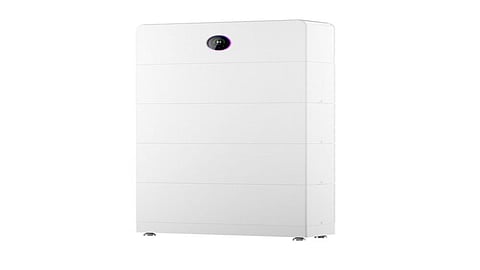

GoodWe’s latest ESS combines a hybrid inverter, vertically stacked battery banks, and an EMS into a compact enclosure
It supports up to 6 identical units in parallel connection, expanding the total storage capacity to up to 288 kWh
With residential applications in focus, this ESS is designed to operate by keeping noise-level to below 29 dB
Solar inverter and energy storage solution provider GoodWe has unveiled its latest 1-phase ESA series energy storage system ESS) to address the growing residential storage market in Europe.
The ESS it combines a hybrid inverter, modular batteries, and ‘intelligent’ energy management system (EMS) into a compact unit. According to the company, ease of installation is one of the unique selling points of this ‘all-in-one' residential ESS platform. While not specifying its weight and dimensions, Goodwe says its compact and lightweight construction simplifies handling during installation. The company claims that the system can be commissioned in 10 minutes using a pre-wired, plug-and-play architecture.
Again, not specifying the number, the company says this product is equipped with MPPT channels with up to 20 A current-carrying capacity. It is designed to support up to 200% oversizing (DC/AC) of its rated AC capacity, maximizing solar harvesting, even during low-light or winter conditions. Regarding the power capacity (AC), it is available in 6 different power ratings: 3 kW, 3.6 kW, 5 kW, 6 kW, 8 kW, and 10 kW. On the storage side, this inverter supports either 5 kWh or 8 kWh battery packs, each with up to 6 units, for a maximum storage capacity of 48 kWh. Thus, a 3 kW inverter can provide a backup for up to 16 hours at the nominal discharge rate during grid outages or faults. Coupled with a smart meter, the electricity arbitrage function enables storing excess solar energy during off-peak hours (low electricity tariff) and discharging the heat or electric vehicle (EV) loads at up to a 1C rate in real time, once the tariff rates come down in a day. According to the company, its capacity (charging/discharging) can be upscaled to up to 288 kWh by parallelly connecting up to 6 identical units.
The above-mentioned complex operations are controlled by the energy management system in real time, while keeping the operational noise level below 29 dB, attributable to the built-in fanless cooling architecture. The company states that the ESS is designed to operate even at ambient temperatures of -20°C without failure, aiming to address Europe’s winter season.
In addition to operational capabilities, this system incorporates a 6-layer protection system from the cell to the system level, addressing overheating, overcurrent, and short-circuit risks. It also includes an integrated aerosol-based fire suppression system. Besides, an AI-based arc fault circuit interruption (AFCI) mechanism continuously analyzes electrical signals to detect and prevent arc faults, reducing fire risks.
The ESS supports an integrated Wi-Fi/LAN-based communication, designed to comply with European cybersecurity requirements, including EN 18031:2024 and CE-RED certification.

