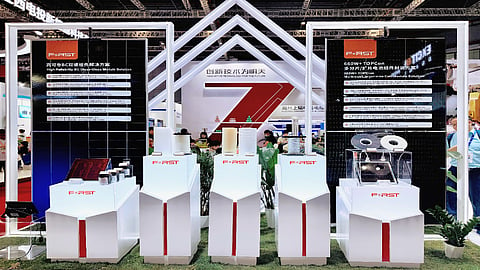

Hangzhou First pitched its coextruded EP304(T) series EPE for front-side encapsulation of the multi-cut gapless TOPCon module
The company also promoted its light conversion film, EP304DC, for additional power gain by converting UV rays into visible sunlight
Also on display was the company’s 0BB cell-to-cell interconnect film, which is suitable for SWCT, IFC, and glue-based processes
Keeping pace with evolving needs, Hangzhou First, a market leader in PV materials, showcased its latest range, focusing on TOPCon and BC modules at SNEC 2026, China.
For multi-cut gapless TOPCon modules, the company promoted its EP304(T) series co-extruded 3-layered EPE film (EVA-POE-EVA). According to the company, this film offers high light transmission, a low water vapor transmission rate (WVTR), and good adhesion strength with glass, cell, and ribbon over field lifetime.
The company’s CF15 series multi-layered coextruded film is inserted between overlapped cell region to minimize mechanical stress that leads to cell cracking. The company also pitched its double-sided coated PET-based insulation strip, which is placed between string busbars and junction box (JB) terminals.
Lastly, for the latest modules with 2 kV system voltage, a few companies have shortened creepage distances compared to IEC standards. This distance is the shortest insulation path between the cell matrix edge and the aluminum frames. Given the severity of up to 33.3% higher DC voltage from the standard 1.5 kV, the company promoted its butyl sealant for edge sealing between glasses and frames. It is a highly impermeable, non-hardening sealant that provides enhanced insulation against humidity and water ingress into the module.
On the BC side of things, Hangzhou First offers its front-side light conversion film (LCF), EP304DC, designed to shift the UV component of sunlight into the visible range, resulting in power gain.
For cell-to-cell interconnection of a zero-busbar (0BB) BC module, the company displayed its CF15 film (briefly discussed above). It comes in 2 different sizes. One matches the module width, while the other equals the cell width. In the ECA-based 0BB interconnection process, the wider film is used as a skin film, whereas the Smart Wire Connect Technology (SWCT) and Integrated Film Covering (IFC) technology solutions use cell-size films as the carrier and cover films, respectively. During contact formation in the lamination process, the low fluidity of molten film helps keep the contact gaps between the fingers and ribbons uncovered, resulting in high-quality electrical contacts.
In parallel, the positive and negative busbars should be alternatively isolated from the fingers on the rear side of a cell. The company showcased its isolating adhesive ink for this application. The company’s protective tapes also help maintain uniform cell-to-cell gaps during lamination, thereby improving BC module yield.

