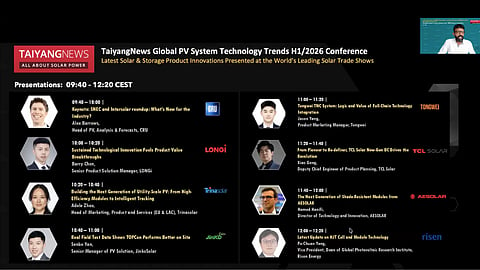


Overcapacity remains a major challenge, according to CRU, while TOPCon 3.0 and advanced metallization are expected to lead near-term innovation
LONGi and TCL Solar advanced BC technology through improved wafers, busbarless metallization, hidden busbars, and full-screen module designs, with LONGi additionally incorporating its Advanced Contact Matrix and integrated conductive backsheet
Trinasolar promoted an integrated solution combining high-efficiency modules, intelligent tracking and storage to shift PV generation toward higher-value hours
JinkoSolar’s field data showed TOPCon outperforming BC references through higher bifaciality and stronger temperature performance, while Tongwei combined rear poly-fingers and advanced cell metallization with quarter-cut cells and an overlapping module layout
AESOLAR’s ShadeStar module maintains higher generation under partial shading while reducing hotspot temperatures and associated safety risks
The TaiyangNews Global PV System Technology Trends H1 2026 Conference, held following SNEC and Intersolar Europe 2026, brought together leading solar and storage companies to examine the technologies and products that stood out at these major exhibitions. Though the solar industry as a whole is going through tough times, the segment has not taken a back seat in terms of innovation. The sheer amount of innovations and product introductions at these events necessitated that we split the conference into two days – July 8th & 15th. An article summarizing Day 1 of the conference has already been published on our website. In this article, we present a summary of Day 2.
Day 2 opened with Shravan Chunduri, Head of Technology at TaiyangNews, providing a brief recap of Day 1 of the conference, followed by the key findings of the latest TaiyangNews TOP SOLAR MODULES Analysis report. Based on data collected over the past 30 months, the report highlights two major technologies that achieve benchmark efficiencies in commercial modules. In April, LONGi and AIKO – two strong representatives of the back-contact (BC) segment – provided proof of commercialization for their BC modules offering 25% efficiency. In the same month, TOPCon surpassed the 24% threshold with JA’s commercial module reaching 24.1%. Heterojunction (HJT) retained its position as a power leader, with Risen’s product rated at 740 W.
Overcapacity Clouds PV Outlook, with TOPCon 3.0 to Dominate
During his keynote, Alex Barrows, Head of PV at market research firm CRU, presented the global solar sector across four areas: markets, costs and prices, technology, and product quality. Barrows noted that while a few segments of the market, such as Europe’s residential sector, which is growing strongly, are showing signs of recovery, the overall global PV downturn driven by China is continuing. He also emphasized that the mid-term growth projection is in question amid China’s 15th Five-Year Plan, which might slow progress toward 2028 and cast doubt on achieving TW-scale annual installations by 2030. However, regions such as Africa, the Middle East, and some Asian markets present potential upside.
Regarding the long-term overcapacity problem, recent mergers and acquisitions have prevented the retirement of considerable capacity from the market, suggesting the overcapacity situation is expected to persist. China’s polysilicon capacity, for example, is estimated at around 3 times market demand. While some companies expect profitability to recover in the second half of 2026, others continue to accept losses.
As a countermeasure, the companies are increasingly diversifying into related areas, mainly storage, while a few have also ventured into power electronics. Prices rose during the first half due to higher material costs for aluminum, silver, and encapsulant, mainly driven by geopolitical disruptions. On policy grounds, China’s withdrawal of export VAT rebate also pushed prices up. All these factors, including the degree of tax enforcement against below-cost pricing, will influence market dynamics, according to Barrows.
In terms of trade, Chinese cell and module exports increased 12% year-on-year during the first 5 months of 2026, although CRU expects the country’s overall export sector to dip by around 5% for the year. India’s cell-level ALMM requirements are a key contributor to this downward trend. Specific to the US cell import market, Africa is gaining traction, with cell capacity additions in Nigeria, Kenya, and Ethiopia. However, the supply of Chinese wafers to these cell fabs may pose a risk of anti-circumvention restrictions. In this context, the Philippines, with its rising cell exports to the US, is likely to be the next target for AD/CVD investigation, according to Barrow.
CRU expects TOPCon 3.0 to dominate the near term, supported by poly-finger structures, edge passivation, multi-cut cells, and overlapping layouts. Barrows was more cautious about BC, whose costs may only reach parity with TOPCon between 2028 and 2030. The two technologies are therefore likely to coexist with increasingly similar efficiencies. And perovskite-silicon tandems are expected to become commercially significant only in the early 2030s.
Continued price pressure is creating serious reliability concerns, particularly delamination and encapsulation failures observed in field testing. Yet many buyers remain unwilling to pay a premium for higher-quality modules. Barrows also highlighted trade risks related to emerging cell supply from Africa and the Philippines, particularly where Chinese wafers could trigger US anti-circumvention or antidumping and countervailing duty investigations.
LONGi Advances BC Technology Through Cell, Module, and Materials Innovation
LONGi, a strong proponent of BC technology, presented the latest technical advancements in its BC product range. According to Senior Product Solution Manager Barry Chen, LONGi’s HIBC technology has achieved 28.13% cell-level efficiency. Incidentally, LONGi also announced a new world record efficiency for a perovskite-silicon tandem cell of 35.5% just one day prior to Chen’s presentation at the TaiyangNews event.
On the commercial front, one of the key innovations adopted by the company's BC platform is its patented Advanced Contact Matrix metallization, which addresses rising silver costs and reliability risks associated with increasingly thin fingers. Its 2-layer alloy structure combines a narrow cell-contact and barrier layer topped with a wider, highly conductive current-carrying layer.
The company’s latest BC technology suite also features an innovative approach to interconnection. While not brand new, LONGi employs an integrated backsheet. According to Chen, it is a 3-in-1 technology with a conventional backsheet on the cell side, and an encapsulation film in the middle, with an intermittent conducting foil layer on top of it. This multilayer structure, mimicking high-WVTR backsheets consisting of metal foils, also serves as a highly effective moisture barrier. However, the solution is only applicable to monofacial modules with an overall power gain of about 3 to 5 W.
This latest product platform, branded Hi-MO X10, also carries forward the advanced features of the Hi-MO 9 Prime series, including a full-screen design enabled by the gapless cell layout and hidden busbars. Emphasizing the growing acceptance of LONGi’s BC technology, Chen noted that following 6 GW of BC module shipments in 2023, LONGi expects volumes to reach close to 100 GW by the end of 2026.
Chen’s presentation also included a summary of LONGi’s progress across other sections of PV. These include TaiRay wafers, RCZ wafer technology, diamond-wire cutting, and perovskite-silicon tandems. Beyond PV, LONGi is expanding into battery storage, green hydrogen, and green methanol. Its BESS portfolio covers distributed generation, C&I, and utility applications, supported by in-house battery and energy management systems. The company’s storage shipment capacity currently stands at up to 13 GWh and is expected to rise to 31 GWh by 2028, with a longer-term target of 100 GWh.
Trinasolar Combines High-Efficiency Modules, Intelligent Tracking, and Storage
Flexibility is becoming a central theme in Europe’s energy transition as rising renewable penetration leads to more frequent curtailment and negative electricity prices. Addressing these imbalances requires solutions that shift generation and consumption across periods rather than relying solely on costly, time-consuming grid expansion. Adele Zhao, Head of Marketing, Product and Technical Service for Europe and Latin America at Trinasolar, presented the company’s approach combining high-efficiency PV modules, intelligent tracking, and battery storage. Citing IEA data, she noted that the incidence of negative electricity prices increased across Europe between 2024 and 2025, strengthening the case for rapidly deployable battery storage and more flexible PV system designs.
Discussing a UK case study, Zhao showed how a 1P tracker, by following the Sun from east to west, can broaden the solar generation profile into the morning and evening periods when electricity tariffs are higher. Compared with fixed-tilt systems, this can enable more electricity to be sold during peak-price hours. Trinasolar’s SuperTracker uses hardware, software, and smart algorithms to optimize tracking and bifacial gains under changing weather, terrain, and low-light conditions. For hilly sites, the Vanguard 1P Terrain+ tracker incorporates terrain-following capability, while independent rack control helps prevent row-to-row shading.
At the module level, Trinasolar showcased its upgraded Vertex G3 series for European rooftops. For utility projects, the company is promoting two modules: Vertex N G3 NEG19RC.20Q with a 670 W power rating and NEG21RC.20Q with 760 W. These modules feature an overlapping gapless design, an inter-cell adhesive buffer layer, and quarter-cut cells. An important advancement in this latest generation of modules is a reduction in the power temperature coefficient to 0.26%. The spec for annual degradation is also lower at 0.35% per year, including the first year, which is typically rated at 1%.
Completing the integrated offering, Trinasolar presented its Elementa 3 DC storage system combined with the Electra 13.8 AC conversion platform. The utility-scale solution provides 13.8 MW/50 MWh of capacity and incorporates 587 Ah cells, power conversion, and liquid-cooling and fire-safety systems.
JinkoSolar’s Field Data Highlights TOPCon’s Energy-Yield Advantage
Long-term field performance is becoming increasingly important, as it reflects how well the STC performance attributes translate into ground reality under real operating conditions. Presenting data from multiple test sites in China, JinkoSolar Senior Manager of PV Solutions Senbo Yan highlighted the performance of TOPCon modules compared with IBC products. His presentation first summarized the officially released field test data by SPIC from the Daqing test base in northeastern China.
The 182 mm cell-based TOPCon modules were monitored for approximately 1,300 days between 2022 and 2025. The location has an average annual irradiance of 900-1,000 W/m². According to Yan, TOPCon modules delivered an average power-generation advantage of 2.27%/W over BC modules. Higher bifaciality was identified as a key contributor, with TOPCon modules achieving 74% bifaciality, compared with 64% for the BC modules. Under 900 W/m² front-side irradiance and an ambient temperature of 25°C, the higher rear-side contribution helped TOPCon achieve a power gain of up to 2.63%. The data also indicated that the yield advantage increased with higher ambient temperatures, reaching up to 3.54% across the evaluated temperature intervals. A second test at Daqing during 2025 showed a 0.75% gain in power output per watt (kWh/kW) for TOPCon. In this comparison, TOPCon bifaciality ranged from 77% to 80%, compared with BC’s 72%.
Yan’s presentation also included field performance data from Wuwei in Gansu province, where annual irradiance reaches approximately 1,600 W/m² and module surface temperatures reach 60°C. The presented data indicated that the company’s TOPCon modules generated up to 1.28% more power per watt than the reference BC modules over a month.
Tongwei’s TNC 3.0 Includes Collective Improvements at Cell and Module Levels
High cell efficiency and nameplate power do not necessarily reflect in corresponding module or field performance. The reasons? Mismatch in optical, electrical, and thermal attributes, emphasized Jason Yang, Product Marketing Manager at Tongwei. Even record-performing cells experience power losses when interconnected and encapsulated into modules. Hotspots, microcracks, and degradations prevent high-power products from realizing power yields.
Tongwei has developed an upgraded platform, TNC 3.0, that combines improvements at both the cell and module levels to address these gaps.
At the cell level, TNC 3.0 uses what Tongwei calls a 360° passivated high-efficiency cell. The key features include passivation optimization of the front, rear, and edges, as well as metallization. The most prominent one is the adoption of a rear-polyfinger structure. According to Yang, the resulting cell reaches 26.3% efficiency, compared with approximately 25.5% for a conventional TOPCon cell. A 210 mm TNC 3.0 cell produces 11.6 W, representing a claimed gain of 0.4 W.
Module-level improvements begin with a quarter-cut cell design. Tongwei says this reduces electrical losses to around one-quarter of those associated with conventional half-cut cells, contributing approximately 4 W of additional module power. The company also employs a high-density layout based on what it calls louvered interconnection, which is essentially an overlapping layout that adds another 5 W by increasing the active cell area within the module.
Yang presented 2 products based on the platform. The G12-66 module reaches 770 W with an efficiency of 24.8%, while the G12R-66 offers up to 670 W at the same efficiency.
Tongwei also highlighted the value proposition of its latest product range in terms of levelized cost of electricity (LCOE). According to Yang, the key attribute is a module bifaciality of up to 90%, which can improve overall energy yield by about 1.2%, potentially translating into a similar increase in project revenue. Yang also highlighted Tongwei’s fully integrated manufacturing value chain and world-class facilities, including a ‘lighthouse factory’ that employs AI, big data analytics, and closed-loop process control to improve efficiency, quality, traceability, and manufacturing costs.
TCL Solar Advances BC Technology From Wafer To Module
TCL Solar is bringing one of the solar industry’s longest-standing BC technology legacies into a new generation of products. Through TCL Zhonghuan’s controlling position in Maxeon / Sunpower, the group now possesses BC know-how developed over several decades. The technology portfolio comprises more than 1,600 patents, concentrated mainly in the US and Europe. The validity period of these patents mainly covers the 2030-2037 timeframe, providing a long-term, predictable window for technology use, as Xiao Geng, Deputy Chief Engineer of Product Planning at TCL Solar, underscores.
The company’s BC development also builds on TCL Zhonghuan’s established wafer expertise with cumulative wafer shipments surpassing 300 GW. According to Geng, the wafers offer minority-carrier lifetimes of up to 10,000 µs and tightly controlled oxygen content. At the cell level, TCL’s BC architecture employs submicron texturing to limit reflectance to below 9.5%. Half-cut wafers and busbarless metallization are claimed to deliver a 5 W power gain over conventional BC cells. Its Pattern OPT process uses new lithography-based patterning to avoid thermal damage from laser patterning and enhance module reliability. The electrode pattern OPT is also said to enhance the low-light coefficient to above 95% under comparable test conditions.
TCL Solar’s C2 series module features a full-screen design with hidden busbars. This facilitates another claimed 5-10 W power gain. Among the products presented, the bifacial G12R-66P reaches 680 W, while the 197-54P monofacial, dual-glass residential module delivers up to 505 W.
AESOLAR’s ShadeStar Targets Rooftop Shading and Hotspot Risks
Shading remains a significant but often underestimated challenge for rooftop PV systems. Hamed Hanifi, Director of Technology and Innovation at AESOLAR, noted that rooftop installations account for as much as 60% of Europe’s PV capacity. Even when cables, chimneys, antennas, or trees shade only around 5% of a module’s active area, the effect can range from a disproportionate power loss to complete module shutdown. Persistent localized shading can also create hotspots, potentially increasing fire risk.
Hanifi explained that an illuminated solar cell operates under forward bias, whereas a shaded cell can become reverse-biased and behave as an electrical load until it reaches the breakdown voltage. The response varies considerably among PERC, TOPCon, and BC technologies, influencing both energy loss and hotspot behavior.
AESOLAR began addressing this issue with its Shade-Free module in 2018, which incorporated 63 bypass diodes. Its latest development, showcased at Intersolar Europe, is the patented ShadeStar module based on segmented-cell technology.
The new module uses 80 G12 half-cut TOPCon cells and delivers up to 440 W of power, with an efficiency of 22.04%. It is backed by product and performance warranties of up to 30 years.
Hanifi presented the comparative results from indoor shade testing of ShadeStar modules benchmarked against TOPCon and BC butterfly-layout modules across several shading scenarios at Fraunhofer CSP. Shading tests were conducted in the horizontal, vertical, and diagonal directions in 9 different possible scenarios. While BC outperformed TOPCon in all cases, ShadeStar outperformed BC modules. Both the reference modules are based on a butterfly design. . Hanifi also presented the evaluation of active and passive diodes, with active diodes found to be advantageous, operating at a lower temperature of up to 30°C.
According to the company, ShadeStar is a module-level advancement that depends on the cell level. Applying the ShadeStar design to BC modules would result in a PV panel that never sleeps during the day due to shading, said Hanifi in his closing remarks.
Risen Attains Cost Parity with HJT with Low Silver Metallization
The sole representation for HJT technology at the conference was from Risen Energy. The company’s CTO, Po-Chuan Yang, presented its progress in HJT, emphasizing not only higher efficiency and module power but also reductions in material consumption and emissions. It claims to have shipped 12 GW of HJT products to more than 80 countries.
Risen’s HJT platform combines G12-format ultrathin wafers, 0BB metallization, reduced silver consumption, and low-stress cell interconnection. According to the company, its n-type, single-junction HJT cell has reached 27.03% efficiency, while its HJT tandem cell has achieved 31.95%.
The company claims to have reduced the silver content in its metallization paste from 60% to 15%, and to have less than 10% silver content in its printed seed-grid process. At this level of silver consumption, Risen’s HJT technology is comparable in costs with TOPCon, according to Yang. He added that Risen is also developing a silver-free metallization process in collaboration with Swiss research institute CSEM.
At the wafer level, Yang says that wafer thinning is an important part of Risen’s cost and carbon-reduction strategy. The company has mass-produced wafers with thicknesses ranging from 100 µm to 110 µm, resulting in finished cells of approximately 95 µm. According to Yang, Risen also has the capability to develop cells thinner than 70 µm. The company is further working with the University of New South Wales on ultra-low-emission PV products based on thinner wafers.
At the module level, Risen’s Hyper-ion Pro series provides power outputs ranging from 720 W to 745 W and reaches efficiencies of up to 24.0%. The products are rated at 90% bifaciality. Looking ahead, Risen is targeting 760 W HJT modules in 2026 to 2027, followed by HJT tandem modules exceeding 850 W in 2028.
Panel: Storage, Advanced Cells, and Application-Specific Modules Lead Product Trends
The panel discussion brought together Alex Barrows of CRU, Adele Zhao of Trinasolar, Hamed Hanifi of AESOLAR, and Xiao Geng of TCL Solar to assess the major trends emerging from SNEC and Intersolar Europe 2026.
Responding to a common question on the three most important developments, the panelists broadly agreed on the growing prominence of energy storage, the continued evolution of TOPCon and BC technologies, and the expansion of application-specific products. System integration – from PV and storage to intelligent home energy systems – was another recurring theme. Moderator Shravan Chunduri added that space PV and cable-based mounting systems are also emerging areas to watch. Barrows identified TOPCon 3.0, particularly rear poly-finger structures and advanced metallization, as one of the most commercially relevant developments. He expects further innovation in silver-copper and copper overprinting, while cautioning that supply of application-specific modules does not always correspond with actual market demand. Zhao emphasized that module performance should not be judged by STC efficiency alone. That’s because factors such as bifaciality, low-light behavior, system costs, and long-term reliability are equally important in determining project value. She also highlighted that integrated solutions tailored to specific project needs are gaining traction.
Hanifi argued that crystalline silicon is approaching its theoretical efficiency limit and that TOPCon and BC will coexist until tandem products reach commercial maturity. In the meantime, reducing cell-to-module losses and assessing products through LCOE offer more meaningful measures of value than nameplate power alone. Geng similarly described efficiency as the foundation rather than the complete value proposition. Future differentiation, he said, will depend on matching modules to customer requirements by improving contacts, spacing, frames, glass, and resistance to wind, hail, and other site-specific conditions. Looking ahead, the panel expects metallization and silver substitution to remain prominent at next year’s exhibitions.
