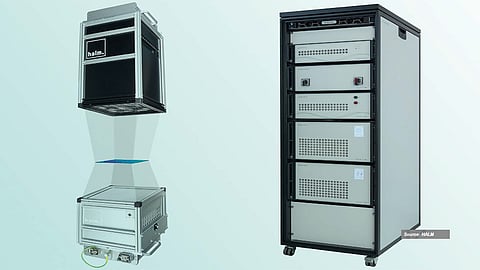


IV testing remains the final performance checkpoint in cell manufacturing, with LED-based illumination increasingly complementing traditional xenon systems
LED sun simulators offer superior spectral tunability, making them particularly suited for tandem and perovskite–silicon cell characterization
Industry consolidation is reshaping the testing landscape, with recent acquisitions expanding capabilities across both cell and module measurement segments
At the very end of the solar cell production line, IV testing serves as the final performance checkpoint. Here, every cell is tested to reveal its true electric performance potential. Cell testers provide a comprehensive assessment of a cell’s electrical characteristics, such as Voc, Isc, output power, and efficiency. The primary purpose of cell testers is to simulate sunlight indoors and conduct IV testing in standard test conditions (STC).
A major technological distinction among cell testers – and a reflection of market trends – lies in the type of light source used. While xenon lamps have long been the industry standard, LED-based illumination has matured into a reliable alternative, offering better spectral control, longer lifespan, and greater consistency over time. According to WAVELABS, its LED engines are rated for over 20,000 hours of operation, an order-of-magnitude improvement over traditional xenon lamps. WAVELABS’ LED-based systems also support advanced spectral tuning across different wavelengths, enhancing the characterization of cell response in both blue and red regions (see WAVELABS’ Perovskite-Si Tandem Technology Characterization Tool).
The company highlights that preferences for cell testers vary by geography. Indian customers tend to demand more advanced measurements beyond simple flashing, even if this results in longer cycle times. Throughput remains the overriding priority, while in the US, there is strong demand for advanced features such as machine-learning integration.
Measuring high-capacitance cells, such as TOPCon or HJT, is no longer a challenge. Both xenon- and LED-based cell testers have mastered this task, as also discussed in the previous survey. The current hot topic in the testing tools segment is the characterization of tandem cell structures. Tandem cells are designed to harness specific parts of the sunlight spectrum. For example, perovskite tandem cells combine a wide-bandgap perovskite top cell with a narrower-bandgap silicon bottom cell. Since each sub-cell absorbs different parts of the spectrum, achieving accurate current matching is essential. This is where LEDs enjoy a clear advantage.
LED sun simulators use multiple independent LED channels, each emitting light at a specific wavelength. This enables high spectral tunability and allows the light profile to be customized to simulate real-world conditions. The level of control also enables independent irradiance adjustment for each sub-cell. LEDs support both balanced and deliberately mismatched conditions for in-depth analysis. Xenon-based systems can be configured for similar tasks, but only with the use of complex filters.
Beyond spectral control, LED systems offer advantages in addressing ion migration and hysteresis effects in perovskites. These cells are prone to measurement instabilities depending on exposure times, illumination history, and pre-biasing conditions. The stable and flicker-free output of LEDs ensures consistent illumination, while long-pulse or continuous light exposure allows cells to stabilize before measurement. The ability to precondition cells with controlled light intensity and duration further improves the reliability of IV readings.
Since perovskite tandem technology is still largely in the research phase, companies such as WAVELABS are seeing growing momentum in the sales of LED-based laboratory tools. This trend is also reflected in the market, as HALM – a long-time advocate and pioneer of xenon-based IV testers – has introduced an LED-based IV tester for laboratory applications.
On the commercial front, several developments have taken place in the IV tester segment. The Netherlands-based Eternal Sun has acquired Germany’s WAVELABS Solar Metrology GmbH, expanding its module testing portfolio to include solar cell measurement capabilities. This follows capital support for Eternal Sun after the sale of a majority stake to Bolster Investment Partners, also based in the Netherlands. In June 2025, Switzerland-based LED solar simulation and PV metrology company Avalon ST acquired PASAN SA, a supplier of xenon-based solar simulators and precision measurement systems. PASAN was previously part of Meyer Burger and remains a legacy of the period when Meyer Burger was the world’s largest wafer and cell equipment manufacturer (see Avalon Strengthens PV Testing Leadership With PASAN Acquisition).
The text is an edited excerpt from TaiyangNews’ latest Market Survey on Solar Cell Production Equipment 2025, which can be downloaded for free here.
