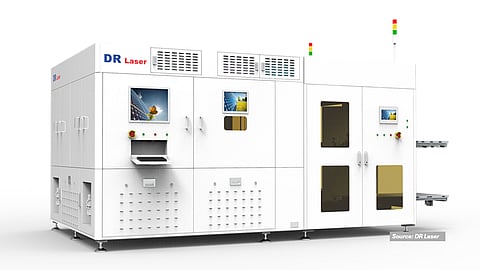


Laser technologies have transitioned from niche applications to core process enablers in TOPCon and BC cell manufacturing, supporting GW-scale production
In TOPCon, laser doping and laser-enhanced contact optimization (LECO) are the dominant applications, enabling precise dopant control
Emerging laser-based patterning approaches, such as polysilicon finger formation, show additional efficiency gains and could become future add-on processes
Laser technology has rapidly evolved from playing a niche role to a mainstream enabler in solar cell production. Today, this is the case for 2 major cell technologies – TOPCon and BC. In fact, lasers are the key enablers for the large-scale rollout of GW-scale cell products fabs built on BC technology. Lasers have several applications in today’s cell manufacturing, including doping, contact formation, ablation, and precision printing. The flexibility, precision, and compatibility with new materials make lasers especially valuable in high-efficiency cell designs where conventional approaches face limitations. The following section provides a cell technology–wise summary of laser applications based on the input from China’s leading laser supplier DR Laser.
TOPCon: Laser technologies have become integral to several stages of TOPCon cell manufacturing. This space is dominated by 2 key laser processes: laser doping for selective emitter formation and laser-assisted contact firing, also referred to as laser enhanced contact optimization (LECO). Laser doping is used to drive dopants, such as boron, into the silicon substrate with high precision; however, due to boron's low diffusivity, this has historically been a challenge. DR Laser has addressed this by developing custom laser sources capable of achieving doping depths up to 2 μm and throughput of up to 8,000 wafers per hour using 4-laser configurations, according to the company’s Vice President of Sales and Marketing, Ben Lee. In contrast, LECO is a non-invasive method in which a red laser excites free carriers, enabling silver ion migration through the tunnel oxide and forming dendritic contact channels under a bias voltage. This avoids the need for a selective emitter in many cases (see DR Laser’s ‘Breakthrough’ LIB For 0BB & XBC Manufacturing).
Beyond these established uses, an emerging application for lasers in TOPCon could be the formation of polysilicon fingers using a laser-defined patterning technique, according to Lee. Applied to the rear side, this approach has already shown an efficiency gain of approximately 0.15%, with ongoing process optimization aimed at meeting the 0.2% target set by customers. If successful, this could become a valuable add-on process for TOPCon manufacturing, Lee adds.
The text is an excerpt from TaiyangNews’ latest report on Solar Cell Production Equipment 2025, which can be downloaded for free here.
