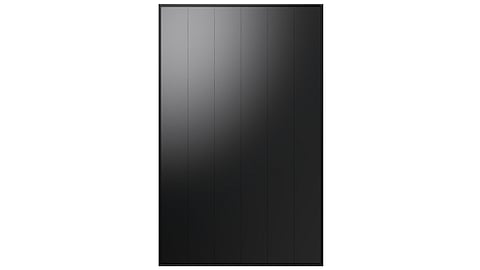


LONGi has launched its Hi-MO X12 BC module series in Europe, offering efficiencies of up to 25.72%
It says the integrated conductive interconnection technology used contributes to a module power gain of up to 20 W
The portfolio includes C&I modules rated up to 690 W and residential modules up to 500 W
Chinese solar manufacturer LONGi has launched its Hi-MO X12 back-contact (BC) solar module series in Europe, with module efficiencies of up to 25.72%. The company uses its Hybrid Passivated Back Contact (HPBC) 2.0 cells across all eight module variants. Of these, six are for commercial and industrial (C&I) applications.
For the European market, LONGi’s 54-cell Hi-MO X12 module delivers up to 525 W at an efficiency of 25.72%. The module that the company presented at All Energy Australia 2026 had the same dimensions, but was rated at 510 W with 24.99% efficiency. The latest specifications thus indicate a power gain of 15 W and an efficiency increase of 0.73 percentage points (see LONGi Showcases New BC Modules At All Energy Australia 2026).
One of the key features of the Hi-MO X12 series, shares LONGi, is the use of Integrated Conductive Interconnection (ICI) technology. The manufacturer uses conductive metal foil instead of conventional interconnection ribbons, eliminating more than 15,000 potential solder-joint failure points per module. The use of metal foil increases the conductive cross-sectional area by 85%. The reduction in electrical resistance alone accounts for a power gain of 6 W to 8 W, it adds.
By overlapping the cells and hiding the busbars, the company makes better use of the module area, contributing an additional power gain of up to 12 W. Together, these two approaches contribute to a module power gain of up to 20 W, according to LONGi.
In terms of reliability, LONGi claims that ICI brings down internal mechanical stress from 50 MPa to 20 MPa, making the cells less prone to microcracks during transportation and installation. The company also reports a 90% reduction in the water vapor transmission rate (WVTR).
LONGi presented the technologies behind this module architecture in July 2026 as part of its Technology Forest portfolio (see LONGi Unveils ‘Technology Forest’ With 8 Core Technologies).
The manufacturer offers three module sizes for the C&I segment. Power ratings range from 495 W to 525 W for the 54-cell format, which measures 1,800 × 1,134 mm. The 60-cell format reaches 580 W at 25.70% efficiency. At 2,382 × 1,134 mm, the 72-cell module is the largest in the series and delivers up to 690 W at 25.54% efficiency.
Under its EcoLife product line, LONGi offers two full-black modules for residential installations – one with single glass and the other with dual glass. Both have a maximum power rating of 500 W and an efficiency of 24.74%.
The power temperature coefficient is −0.26%/°C. Under its 30-year performance warranty, it specifies a maximum degradation of 1% in the first year and 0.35% annually thereafter. The warranted power at the end of 30 years is 88.85% of the initial rating. LONGi expects to start deliveries in Europe in January 2027.