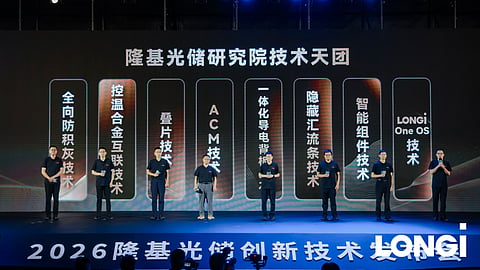


LONGi unveiled 8 core technologies and products under its ‘Technology Forest’ portfolio
The key technologies include ACM metallization and integrated conductive backsheet technology
LONGi announced a 35.5% conversion efficiency for its silicon-perovskite tandem solar cell
Leading solar manufacturer LONGi has introduced a multidisciplinary technology portfolio, which the company calls ‘Technology Forest’, an English translation of a Chinese metaphor indicating the company’s shift from isolated, single-point technological upgrades to a cross-disciplinary, modular platform of innovations. The portfolio covers technologies from Advanced Contact Matrix (ACM)Technology, Integrated Conductive Backsheet Technology, Shingled Cell Technology, Hidden Busbar Technology, Selective Temperature Alloy Connection (STAC), Smart Module Technology, LONGi One OS, and Hi-MO X10 Pro modules. According to LONGi, each technology functions independently and can be applied in products for different applications.
In parallel, the company announced on July 14, 2026, that it had achieved a world-record perovskite tandem cell efficiency of 35.5%, certified by European Solar Test Installation (ESTI). This achievement is already beyond the 33.7% Shockley-Queisser limit for single-junction solar cells. The theoretical efficiency limit for crystalline silicon-perovskite tandem cells is estimated around 43%. The company, however, did not reveal the technical details for the latest tandem cell and its expected commercialization date (see LONGi Sets 35.5% Silicon-Perovskite Tandem Cell Efficiency Record).
LONGi’s Advanced Contact Matrix (ACM) is a metallization technology that combines material and process innovations. Material innovations include the use of the company’s patented nano-alloy material and nanoscale anti-oxidation surface treatment that reduce electrical resistance. According to the company, the ACM gridlines have 50% lower electrical resistance than traditional TOPCon products. Another innovation on the process side is the matrix design that separates the contact and transmission layers. The smaller contact area reduces recombination losses, while the transmission layer supports uniform current flow.
Integrating these technologies into its Hi-MO 9 and Hi-MO X10 modules increases mass-production conversion efficiency by 0.2-0.3% and power output to 672 W, the company claims.
LONGi also introduced its 3-in-1 Integrated Conductive Backsheet Technology, which integrates the rear encapsulant film, conductive metal foil, and backsheet into a single roll. The design replaces conventional point-contact solder ribbons with full-area metal foil contact. According to the company, this increases the current-transmission cross-section by more than 85% and reduces stress on cells by 60%. LONGi also claims a 90% reduction in water-vapor transmission. In addition, the reflective metal foil reflects some of the light passing through the silicon back into the cell, adding 3-5 W to the module power output.
The company presented Shingled Cell and Hidden Busbar technologies to increase the module’s active area. The Shingled Cell Technology uses a 0.4 mm overlap between adjacent cell pieces, replacing the conventional 2 to 3 mm gaps. This boosts the module’s effective power-generating area by 2%, says the company.
Its Hidden Busbar Technology relocates the busbars to the rear of the cell, eliminating front-side busbar shading and increasing the light-receiving area by 1.1%.
To reduce the risk of microcracks and cell breakage, LONGi introduced its Selective Temperature Alloy Connection (STAC) Technology. The process uses low-temperature bonding to reduce thermal stress during cell interconnection.
LONGi says the combined use of these technologies in a module measuring 2,382 × 1,134 mm can deliver more than 690 W and 25.54% efficiency.
The technology portfolio also includes the Hi-MO X10 Pro BC module, which combines ACM with an anti-dust coating and an upgraded frame. Rated at up to 670 W and 24.7% efficiency, the module is designed to provide anti-dust performance in horizontal and vertical installations.
The company’s Smart Module is equipped with a dedicated maximum power point tracking (MPPT) unit for each module to reduce power loss due to partial shading. LONGi claims a 5%-30% increase in generation under shaded conditions. The product also provides module-level monitoring and rapid shutdown, reducing DC voltage to below 30 V within 20 seconds. The company plans to launch the Smart Module globally in Brazil on August 25, 2026, with mass deliveries scheduled to begin in October.
Beyond module technologies, the portfolio also includes LONGI One OS, an energy management software platform that integrates PV generation, energy storage, EV charging, and electrical loads. Its AI agent uses electricity prices, weather, power generation and load forecasts to optimize battery charging and discharging every 15 minutes. According to the company, its remote support, fault diagnosis, and early warning functions improve O&M efficiency by 90%.
