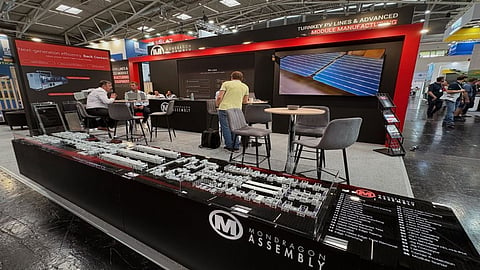

Mondragon Assembly promoted its MTS-LAB0 for laboratory and MTS-BC stringers for commercial-scale BC module fabrication
Both tools support up to G12-size BC cells, either in full or cut cell configuration, and low-temperature ECA-based cell-to-cell stringing
The industrial-scale stringer can be configured for 0BB BC cells
The company’s new modular EOL PV recycling line operates on non-destructive water-jet delamination technology
Spain-based PV module production tools provider Mondragon Assembly promoted its latest offerings in line with current PV technology trends at Intersolar Europe 2026. Unlike its emphasis on turnkey production lines last year, the company expanded its showcase with tailor-made BC process tools and PV recycling lines this year (see Mondragon Assembly: Spanish Engineered Turnkey PV Module Production Line).
For cell-to-cell interconnection or stringing processes, the company highlighted its MTS-LAB0 series tool for laboratory-scale operations. Focusing on back-contact (BC) cell technology, it is designed for cell sizes of up to G12 and can process cut cells, facilitating R&D flexibility. In terms of stringing processes, it is compatible with a solder-free, low-temperature process using an electrically conductive adhesive (ECA). This technology also enables shingling interconnection, facilitating cell-to-cell overlapping along the edges. The tool also supports standard soldering wire-based stringing. With a changing bill of materials (BoM), laboratories can easily adapt to different cell sizes or technologies, as well as changing ribbon quantities, says the company.
Mondragon also pitched its latest industrial-scale BC cell stringer, MTS-BC, which is compatible with cell sizes up to G12 and supports both cut and full cells. It is also designed for low-temperature ECA and traditional IR-soldering-based stringing. The company says it can also be upgraded for zero-busbar (0BB) BC cells.
In terms of end-of-life (EOL) PV module recycling, the company promoted its latest modular solution, which is available from single machines to a complete turnkey line. According to the company, this solution prioritizes the quality of the recycled materials, such as glass, silicon, and silver, among others, over volume. Its junction box (JB) and deframing station separate the single- or split-type JBs and aluminum frames from the module. This tool has a rated throughput of 60 pieces per hour (PPH) or 1.5 tons/hour. The module laminate then goes through a water-jet delamination process, in which a high-pressure water jet separates the tightly bonded layers of glass, solar cells, encapsulant, and backsheet. Unlike traditional mechanical delamination, it is a non-destructive technology that delivers clean glass in one piece and helps in the recovery of Si and silver at an acceptable purity level. It can process up to 40 module laminates per hour, equivalent to 1 ton/hour.

