

Recent advances in edge passivation have enabled the commercial adoption of multi-cut module designs by reducing edge-related losses
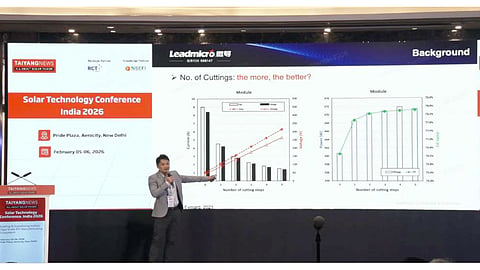
Multi-cut modules reduce series-resistance losses by lowering the current through each cell segment, although performance gains diminish with additional cuts
Commercial deployment of multi-cut modules is increasing as manufacturers optimize cell layouts for higher module power
Module-level developments are increasingly contributing to the overall performance progress of PV. On the other hand, module manufacturing is more of an assembly than a true processing station. And the key steps are interconnection, layup, and lamination. While lamination is a very straightforward process, the developments are mostly related to interconnection and layup. However, module making is also a game of materials. By optimizing the BOM, PV modules are increasingly custom-tailored for different applications.
Multi-Cut Modules
Strictly speaking, in terms of technology, multi-cut is one of the key recent trends in module manufacturing. Here, instead of cutting cells into 2, 3, or 4 slices, they are cut from fully processed cells. The idea is not altogether new; a few companies in the past have commercialized modules based on this approach. Also, shingled module technology follows the same track but uses a more complex interconnection approach. The main reason these multi-cut modules did not make it to the mainstream in the past was the high level of edge losses resulting from cell slicing. What has changed now is the latest cell technology trend – edge passivation.
As for the benefit, the rationale is the same as for a half-cell: cutting a cell into smaller segments reduces the current per cell, thereby reducing series-resistance losses, while increasing the operational voltage. But the benefit is not linear. Addressing the question “the more, the better?”, Leadmicro’s CTO Baochen Liao emphasized that performance benefits most with half-cell and diminishes with increasing cuts, as shown in the graph below. Thus, different companies are finding a sweet spot at either 2 or 3 cuts, resulting in 3 or 4 slices, respectively.
While not exclusive, the technology was widely adopted in TOPCon first, followed by first movers from HJT. The BC domain, however, has yet to see its benefits. Edge passivation is not yet broadly optimized for BC, which, due to the absence of front contacts, is not fully compatible with standard edge passivation tools. The application of multi-cut in HJT is also somewhat restricted, as HJT has already broadly adopted half-wafer processing. This eliminates the option of a 1/3rd-cell layout (unless the company is still based on full-wafer processing), while a quarter-cut layout is possible.
Several leading companies introduced module products based on multi-cut at last year’s Intersolar Europe and SNEC (see report). A few companies have also commercialized the technology. In fact, the key technological progress associated with JA Solar’s DeepBlue 5.0 module series, which reached 24.1% efficiency on a commercial scale, is multi-cut. By implementing 1/3-cut cells, JA Solar achieved 7-8 W power gain at the module level.
The text is an edited excerpt from TaiyangNews’ report on Cell & Module Technology Trends 2026, which can be downloaded for free here.
