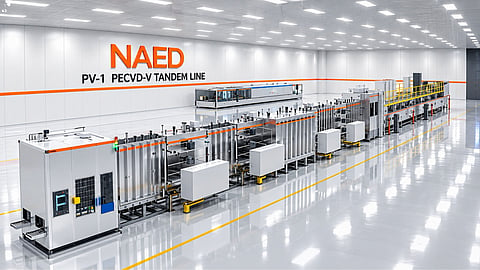


NAED combines PECVD and PVD processes on a single production line using a common vertical wafer carrier
Each production line has a rated throughput of 16,000 G12 half-cut wafers per hour
The company targets 30% tandem cell efficiency and estimates an annual production capacity of 788 MW per line
US-based aerospace and engineering company NAED Energy Holding has unveiled a vertical deposition platform for large-scale manufacturing of perovskite-silicon tandem solar cells. The new platform, PV-1 PECVD-V, integrates plasma-enhanced chemical vapor deposition (PECVD) and physical vapor deposition (PVD). Both processes use the same wafer carrier.
Each carrier holds 400 wafers, which are placed vertically. After deposition on one side of the wafers, the equipment rotates the entire carrier by 180° under vacuum to coat the other side. This avoids the need to handle individual wafers between deposition steps and could also reduce wafer breakage. According to NAED, the vertical architecture doubles the rated throughput from 48,000 wafers per hour for its previous XL-class platform to 96,000 wafers per hour. The latter represents the combined throughput of six production lines, each rated at 16,000 G12 half-cut wafers per hour.
The PVD process determines the overall throughput of the production line. While the four PECVD modules operate at a 76-second processing interval, the PVD tool operates at a 90-second interval. This limits the line throughput to 16,000 wafers per hour, compared to the PECVD section’s rated throughput of around 18,950 wafers per hour. As an industry benchmark, NAED refers to the horizontal inline GENERIS PECVD tool from Germany’s SINGULUS TECHNOLOGIES, which has a throughput of over 14,000 G12 half-cut wafers per hour for heterojunction (HJT) core layer deposition, as previously reported by TaiyangNews (see Singulus Technologies: Gigawatt-Scale HJT Production Tools).
NAED’s 2-terminal T2X tandem solar cell combines a perovskite top cell with a bandgap of around 1.7 eV and an HJT bottom cell with a bandgap of around 1.1 eV. The company is targeting 30% cell efficiency for production, compared with 34.4% in device simulations.
At 30% cell efficiency, each line would have an annual production capacity of around 788 MW, according to NAED. This translates into 4.7 GW for six lines. The calculation assumes an overall equipment effectiveness (OEE) of 85%, which also factors in production yield.
All process equipment is designed and built by NAED at its own facilities in the US. Of the 13 process tools, the company had initially completed six and was working on the remaining seven. NAED has since reported an average throughput of 16,007 wafers per hour from three 24-hour test runs. However, the company has yet to publish measured tandem-cell efficiencies or long-term production yields.
The company sees applications for its T2X cells both on Earth and in space, with plans to also introduce glass-glass modules starting at 600 W.