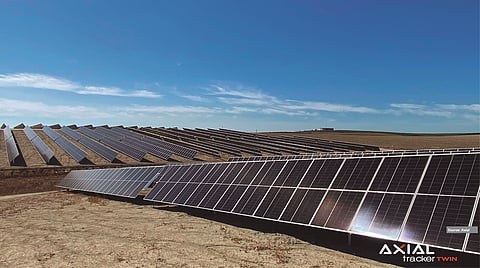


Tracker design selection varies based on project needs, including terrain, land availability, and system layout
Structural improvements are helping optimize installation and material use, such as longer row designs and reduced pile requirements
Module size and site conditions continue to influence design choices, affecting structure, stability, and overall system performance
As tracker configurations continue to evolve, suppliers highlight the importance of site-specific design choices. Antaisolar states that the selection of tracker configuration depends on terrain suitability, cost, and energy yield. 1P systems are preferred on flat and regular sites due to their simpler structure, lower capital costs, and efficient land use. Due to their shorter table length, 2P systems remain relevant on complex or uneven terrain, where reduced grading and lower pile counts offset slightly higher structural cost. Antai notes that 2P trackers can also help capture more diffuse light in morning, evening, and cloudy conditions. Antai has introduced an octagonal torque tube to improve span length and reduce material consumption.
The new profile delivers 40% higher stiffness and 50% higher strength than common square tubes. It supports row lengths up to 143 m, enabling a 20% reduction in piles and lowering torque-tube costs by up to 30% without compromising torsional behavior.
Axial also remains neutral, offering products based on both configurations. the company identifies a business case for 2P when developers must install additional DC capacity on constrained plots. Axial sees potential for increased 2P adoption in regions where reduced pile count and streamlined installation are valuable, provided that the mechanical design is sufficiently resilient. The pros of 1P listed by the company are no different from those discussed above, and the same is true for Solar Steel. However, for 2P, Solar Steel sees Europe maintaining a stronger preference for 2P in a few markets. For land-constrained applications, which require higher GCT, the company continues to offer a compact 2P system with one string per row. PVH also admits to 1P’s dominance, but underscores that 2P still has use cases that require larger modules (see Solar Tracker Designs Shift Toward Simpler Configurations).
Speaking about the downsides of 2P, Soltec notes that as module sizes approach 600 to 700 W, taller 2P structures require heavier steel reinforcement due to their higher wind exposure, making them less suitable for many large utility-scale sites. Even so, 2P remains relevant in land-constrained projects, especially in Europe, and agrivoltaic applications where higher clearance is beneficial, while the company notes that global demand continues to shift towards 1P.
Zimmermann views 1P tracker systems as the economically preferred configuration under current market conditions, particularly as the industry continues to adopt large-format, high-power modules. According to the company, the cost advantages associated with 1P designs have driven a broader industry shift away from 2P architectures. At the same time, Zimmermann notes that 2P systems are regaining relevance in specific niche applications, most notably in agrivoltaic projects where larger row pitches and dual land-use requirements can offset the higher structural complexity. This points to a growing divergence in tracker configuration choices, with 1P emerging as the default for conventional utility-scale projects and 2P increasingly confined to application-driven use cases.
Zimmermann attributes the dominance of the 1P tracker mainly to the cost advantage, particularly as the industry continues to adopt large-format and high-power modules. At the same time, the company notes that 2P systems are regaining relevance in specific niche applications, most notably in Agri-PV projects.
To summarize, 2P remains relevant in specific niche application scenarios, especially agrivoltaics, irregular plots, and space-constrained projects. However, prevailing industry trends point clearly to 1P as the mainstream configuration for large-scale solar deployment. The key distinction today is not whether suppliers offer both 1P and 2P systems, but how effectively they adapt each configuration to specific site conditions and project needs.
The text is an edited excerpt from TaiyangNews’ Market Survey on Solar Trackers 2026, which can be downloaded for free here.
