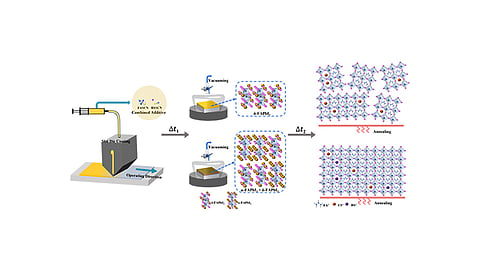


Researchers developed a 2-additive strategy to improve uniform crystallization of perovskite films during slot-die coating in ambient air
The approach extended the processing window to over 100 seconds, with a 54.80 cm² module achieving 22.70% efficiency
Unencapsulated devices retained 97.76% of their initial efficiency after 1,300 hours of continuous operation at 65°C
Perovskite solar cells have achieved high efficiencies in laboratory tests, but producing uniform, high-quality films over larger areas remains a challenge. Maintaining consistent film quality becomes more difficult when manufacturing takes place in ambient air, where processing conditions can affect crystallization.
Researchers at the Dalian Institute of Chemical Physics (DICP) and Dalian Jiaotong University have modified the slot-die coating process to address the issue. The changes extend the processing window for uniform crystallization while also improving the efficiency and operational stability of the resulting solar cells.
Slot-die coating is a method used to deposit perovskite films over large areas and can also be used in continuous manufacturing. The researchers focused on methylammonium-free (MA-free) perovskites, which offer better stability but are more difficult to crystallize uniformly.
The researchers introduced 2 additives to address the above issue: formamidinium thiocyanate (FASCN) and rubidium thiocyanate (RbSCN). The former helps control crystal formation and growth; the latter additive improves the stability of the photoactive perovskite phase. Together, they extended the processing window for uniform crystallization to more than 100 seconds. The resulting films showed larger crystal grains, a denser structure and reduced internal stress.
The improved film quality also translated into higher device efficiency. Small-area solar cells achieved a power conversion efficiency of 26.16%. A larger module with an active area of 54.80 cm² reached 22.70%, compared with 15.8% for a control module without the additive treatment. This represents an improvement of 6.9 percentage points at the module level.
The researchers also reported improved operational stability. Unencapsulated devices retained 97.76% of their initial efficiency after 1,300 hours of continuous maximum power point tracking under simulated sunlight at 65°C. In comparison, control devices retained 65.86% under the same conditions.
Better control over crystallization can improve perovskite film quality during large-area coating. Earlier research at the University of California, San Diego (UC San Diego) has also explored the use of additives to control crystal growth and reduce defects in perovskite solar cells (see Temporary Liquid Helps Reduce Perovskite Defects).