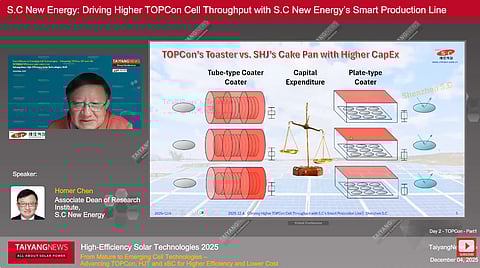


TOPCon continues to strengthen its position as the leading crystalline silicon technology, supported by CapEx, established industrial experience, and strong efficiency potential
Shenzhen S.C. highlighted its tube-type deposition platforms, designed to support cost-efficient and high-throughput TOPCon cell production
Advances in automation, AI-assisted process control, and higher-capacity tubular tools are enabling the next generation of smart TOPCon production lines
TOPCon technology has emerged as the dominant architecture in crystalline silicon solar cell manufacturing. Following the large-scale transition from PERC over the past few years, TOPCon production capacity has expanded across major PV manufacturing regions. The technology is gaining traction due to its compatibility with existing manufacturing infrastructure, relatively moderate capital investment, and potential for further efficiency improvements.
During the TaiyangNews High-Efficiency Solar Technologies Conference, Homer Chen, Associate Dean of the Research Institute at Shenzhen S.C New Energy, presented the company’s perspective on smart production lines for TOPCon manufacturing. His presentation, titled Driving Higher TOPCon Cell Throughput with S.C’s Smart Production Line, examined the role of TOPCon in industrial PV production and discussed developments in equipment platforms, automation, and high-capacity production lines designed to support large-scale cell manufacturing.
According to Chen, the industry continues to evaluate multiple technology pathways. Heterojunction (HJT) and BC technologies have gained significant attention but still face cost and process challenges at large-scale manufacturing. Perovskite-based technologies are also advancing, although questions remain about long-term stability and material degradation.
Under current industrial conditions, TOPCon offers a favorable return on investment. The payback period for TOPCon production lines is expected to be shorter than 3 years, driven largely by lower capital investment and established manufacturing infrastructure.
The presentation also discussed the transition from PERC to TOPCon and the resulting structural changes in solar cell design. In addition to moving from p-type to n-type wafers, the architecture incorporates an ultra-thin tunneling oxide layer combined with a doped polysilicon contact. This structure improves carrier selectivity and reduces recombination losses. It also provides higher thermal stability, increases bifaciality, and lowers susceptibility to potential-induced degradation (PID), Chen explained.
From an equipment perspective, the speaker highlighted structural differences between deposition systems used in competing technologies. Heterojunction manufacturing typically relies on plate-type deposition tools, while TOPCon production primarily utilizes tubular deposition platforms.
This distinction has significant implications for capital expenditure (CapEx). According to the comparison presented, equipment investment levels correspond roughly to a ratio of 1x for TOPCon technology, 2x for xBC, and 3x for HJT.
Although the TOPCon process flow is somewhat longer and requires slightly higher labor input, the overall non-wafer production cost remains lower. The use of conventional metallization pastes and mature processing infrastructure contributes to this cost advantage.
Chen highlighted another advantage of TOPCon cells: the flexibility in module manufacturing. Solar cells are often cut into half-cut, 1/3-cut, or 1/4-cut formats to optimize current levels and reduce resistive losses. In TOPCon production, the cutting process can be performed at the end of the cell manufacturing line. This allows module manufacturers to select the cutting configuration based on product design requirements. The ratio between installed TOPCon and HJT manufacturing capacity is estimated at approximately 52:1, he added.
Addressing developments in smart manufacturing for TOPCon production lines, Chen’s presentation highlighted the rapid scale-up of PV manufacturing capacity. Earlier cell production lines were typically designed for around 500 MW, while modern facilities increasingly exceed 10 GW. Larger production scales help reduce unit manufacturing costs and improve overall efficiency. At the same time, higher levels of automation are reducing labor requirements while improving process stability. The next step is to integrate artificial intelligence into production-line control systems to enable process optimization.
The presentation also highlighted the role of tubular equipment platforms in TOPCon production. Tube-type systems support uniform thin-film deposition across large wafer batches, enabling high throughput and consistent cell performance. According to Homer, tubular tools can produce a higher share of cells in the top efficiency range compared with plate-type deposition approaches.
An analysis comparing PECVD and LPCVD polysilicon deposition processes showed that PECVD produced a larger proportion of cells in the higher-efficiency ranges. PECVD platforms offer advantages such as in-situ doping and multi-step process integration, which can improve process efficiency. LPCVD systems rely on quartz tubes that experience thermal stress and must be replaced periodically, adding operational complexity.
The presentation also highlighted ongoing efficiency improvements in industrial TOPCon production. According to Chen, current manufacturing lines already achieve average cell efficiencies of around 25.5% with production yields approaching 98%.
Further improvements are expected through the optimization of several key parameters. One critical factor is the precise control of tunneling oxide thickness, which directly affects carrier transport across the passivating contact.
He also referenced several process innovations currently being adopted by manufacturers. These include the use of low-temperature metallization pastes, wider-bandgap polysilicon materials, and improved bifacial cell designs. In addition, laser-enhanced contact optimization (LECO) technology is increasingly being implemented in TOPCon production. This approach can reduce the need for selective emitter structures while maintaining high cell efficiency.
Looking ahead, Shenzhen S.C.’s TOPCon equipment platforms are also being developed to support next-generation architectures, including tunnel oxide back-contact (TBC) structures. Increasing open-circuit voltage (Voc) remains a key target for further efficiency gains, says Chen, adding that achieving this requires precise control of the tunneling oxide interface and careful management of process timing across the production line.
From an equipment perspective, PECVD platforms are expected to remain central to TOPCon manufacturing while also supporting future cell architectures. The current equipment ecosystem already supports production capacities exceeding 800 GW.
To access the full presentation video, titled "Clever Solutions for High-Performance n-Type Modules", click here.
