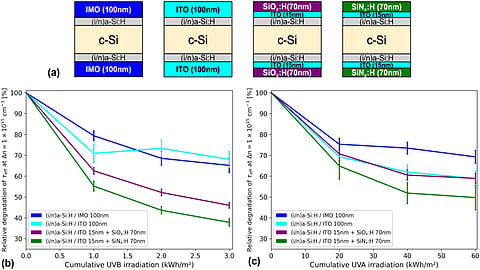


UV-induced degradation in SHJ solar cells is mainly driven by the front (i/n) amorphous silicon layers, where hydrogen-related effects cause losses in carrier lifetime and passivation
Higher phosphine doping increases initial passivation but significantly worsens UV stability, with heavily doped samples showing strong lifetime losses under prolonged UVA exposure
Light soaking can partially recover UV-induced performance losses, but the extent of recovery depends on the UV spectrum
Silicon heterojunction (SHJ) solar cells are widely regarded as one of the leading high-efficiency solar cell technologies. However, questions remain over their long-term stability under ultraviolet (UV) exposure. A research paper titled “Understanding UV-Induced Degradation Mechanisms in SHJ Solar Cells and Their Reversibility: The Role of Hydrogen and Doping” shows that UV-induced degradation (UVID) leads to measurable losses in open-circuit voltage (Voc) and carrier lifetime.
The study focused on identifying the root causes of UVID in SHJ solar cells. It analyzed the impact of the transparent conductive oxide (TCO) and the hydrogenated amorphous silicon layers under controlled UVA and UVB exposure. The tests for UV aging were calibrated to represent realistic module conditions. The filtering effects of commercial glass and encapsulants were included. The results indicated that the front-side TCO plays a role under UVB exposure due to its absorption behavior. However, the primary contributor to UV-related performance degradation was the front (i/n) a-Si:H layer.
To assess the impact of UV exposure on surface passivation, the researchers analyzed minority carrier lifetime. The measurements showed substantial passivation losses, particularly in samples with higher phosphine (PH₃) doping in the front amorphous silicon layer. Under UVA exposure equivalent to 60 kWh/m², heavily doped samples experienced lifetime reductions of more than 60%, while intrinsic layers showed only minor degradation. The researchers state that this strong dependence on dopant concentration indicates that UVID in SHJ devices is closely linked to the interaction between hydrogen and electrically active dopants.
Fourier-transform infrared spectroscopy revealed the mechanism of UVID. UV exposure selectively reduced high stretching mode Si-Hₙ bonds. These bonds are associated with hydrogen located in weakly bonded or void-rich regions. Breaking these bonds releases mobile hydrogen. This hydrogen interacts with phosphorus dopants to form electrically inactive P-H complexes. As a result, chemical passivation at the c-Si/a-Si interface is degraded. Field-effect passivation is also reduced due to lower effective dopant activation.
Electrical conductivity measurements on doped amorphous silicon layers confirmed this mechanism. Following UV exposure, conductivity dropped sharply, consistent with dopant deactivation. Subsequent light-soaking treatments partially restored conductivity, indicating that hydrogen redistribution and dopant reactivation can occur under combined thermal and photon stimulation. However, this recovery was found to be strongly dependent on the UV dose and spectrum.
Light-soaking proved significantly more effective in reversing UVB-induced degradation than UVA-induced degradation. While up to 77% of UVB-related iVoc losses could be recovered, only around 35% recovery was observed after high-dose UVA exposure. This suggests the existence of a photon-dose-dependent threshold beyond which UV-induced damage becomes increasingly irreversible, particularly under prolonged UVA exposure, where photon flux is higher.
The findings indicate that UVID in SHJ solar cells is not governed solely by Si-H bond breaking, but by the subsequent migration and interaction of hydrogen with dopant atoms. Higher doping levels increase initial field-effect passivation but simultaneously raise sensitivity to UV exposure by promoting dopant deactivation through hydrogen complex formation. This trade-off has direct implications for the design of front-side selective layers in SHJ devices.
From an industrial perspective, the results highlight the importance of managing hydrogen bonding configurations and dopant concentrations in amorphous silicon layers, as well as relying on module-level UV filtering. While emerging selective layers such as nanocrystalline silicon and silicon oxide alloys offer electrical advantages, their hydrogen-rich nature may expose similar vulnerabilities under UV stress.
TaiyangNews is bringing together the Indian solar PV manufacturing industry for the Solar Technology Conference India 2026 (STC.I 2026). To be held on February 5 and 6 in Aerocity, New Delhi, this 2nd edition of the TaiyangNews physical conference will also have banks, investors, and policymakers in attendance. Register for the event here.
