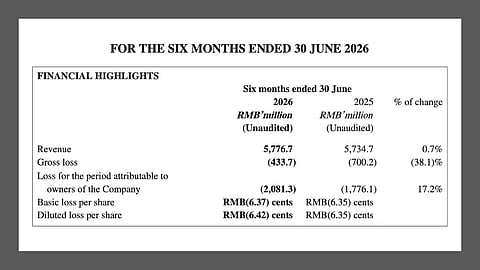


GCL Technology's revenue remained broadly stable, but weak polysilicon and wafer prices continued to weigh on its profitability
GCL SI's revenue fell sharply amid oversupply, with overseas markets and large orders providing some support
Both companies are expanding beyond conventional PV, with GCL Technology pursuing perovskite and GCL SI developing BC, tandem and space-solar
The prolonged downturn in the solar manufacturing market continued to weigh on the H1 2026 financial results of GCL Group’s solar companies. Both—the group’s polysilicon producer GCL Technology as well as its solar PV cells wafer-cell-module-systems production arm GCL System Integration (GCL SI)—reported losses, but are focusing future growth on newer technologies.
During H1 2026, GCL Technology reported revenue of RMB 5.77 billion, broadly unchanged from RMB 5.73 billion a year earlier, representing 0.7% year-on-year (YoY) increase.
However, the company remained under pressure from weak pricing in the polysilicon and wafer markets. Its gross loss nevertheless narrowed to RMB 434 million from RMB 700 million, with 38.1% annual decline, while the loss attributable to owners widened to RMB 2.08 billion from RMB 1.77 billion.
GCL Technology said H1 2026 half was ‘the most concentrated period of pressure’ for the PV industry in recent years. Average polysilicon and wafer prices fell below the cash costs of most producers, while high polysilicon inventories also affected selling prices and sales volumes for its granular polysilicon.
During the reporting period, the company said its average external selling price for granular polysilicon was RMB 31.97/kg, while its average production cash cost was RMB 25.23/kg.
Its solar materials business generated RMB 5.73 billion in revenue, accounting for almost all of the group's total revenue to which polysilicon sales contributed RMB 3.88 billion. Wafer sales followed at RMB 696 million and industrial silicon at RMB 344 million.
As of June 30, 2026, GCL Technology had 480,000 metric tons (MT) of granular polysilicon production capacity.
The company is also looking beyond its traditional solar materials business. GCL Technology expanded into cathode material business through its non-wholly owned subsidiary Leshan Xinneng New Materials Technology. The latter, in which GCL holds an indirect equity interest of 30%, is manufactures and sells lithium iron phosphate cathode materials (see China Solar PV News Snippets).
Perovskite is another technology stream GCL is expanding into, with a focus on perovskite-silicon tandem modules. In H1 2026, the world’s ‘first’ GW-scale perovskite-silicon tandem module production line, Kunshan GCL, entered stable operations, while the company advanced commercial orders and demonstration projects.
GCL Technology reported net loss for FY 2025, but managed to turn a positive adjusted EBITDA (see GCL Technology Revenue Falls, But Loss Narrows In 2025).
GCL SI, meanwhile, operates further downstream in the solar supply chain and is focused on cells, modules, storage products and PV solutions. It also faced a difficult H1 2026 as its operating revenue fell 39.7% YoY to RMB 4.64 billion, while net loss widened to RMB 430.2 million with a 31.6% jump.
The management linked the pressure to weak end-market demand, industry overcapacity and lower prices across the PV supply chain. China’s solar PV module manufacturing capacity exceeded 1.1 TW while global module demand is expected to reach around 536 GW in 2026. This means lower capacity utilization, it pointed out.
Solar modules remained the company's main business. Module revenue was RMB 4.19 billion in the first half, while system integration services contributed RMB 149.5 million and cell sales RMB 243.9 million.
Overseas revenue stood at RMB1.11 billion, with markets outside China accounting for a smaller but growing part of the business. Domestic market accounted for 76.10% of the total revenue with an annual decline of 50.08%, while overseas expanded its share by 78.36% YoY to 23.90%.
GCL SI said it secured more than 1.5 GW of large orders in markets including South Asia and Europe. It is also strengthening its presence in the Middle East, Africa and East Asia.
GCL SI had 30 GW of high-efficiency N-type module capacity at the end of June. Some production lines can also manufacture XBC products, allowing the company to adjust capacity as demand shifts between technologies.
The company said its module business maintained relatively high capacity utilization during the industry downturn. GCL SI said its GPC back-contact technology reached an average cell conversion efficiency of more than 28.36%. Its GPC 3.0 all-black modules have entered mass production, while the company plans to add 8 GW of GPC production capacity from H2 2026 through H1 2027.
Perovskite is another technology stream GCL SI is expanding into. During the first half, the company continued development of GTC perovskite-silicon tandem cells with Soochow University and other research partners. Its small-area two-terminal GTC1.0 cell reached an internally tested efficiency of 33.02%, while a three-terminal GTC2.0 sample using a BC bottom cell reached 29.05%.
Space solar PV is another area of interest with the company working on materials and cell technologies designed to withstand radiation, thermal cycling and vibration. It reported an efficiency of 21.5% for an AM0 thin-film crystalline-silicon cell designed for space applications.
This gives GCL SI a technology roadmap that extends beyond conventional TOPCon modules, with BC mass production and perovskite tandem development emerging as two key areas of focus.
At the TaiyangNews Next-Gen PV Technologies Conference 2026, GCL SI presented its GPC 3.0 back-contact platform (see GCL SI Details BC And Tandem Technologies).
