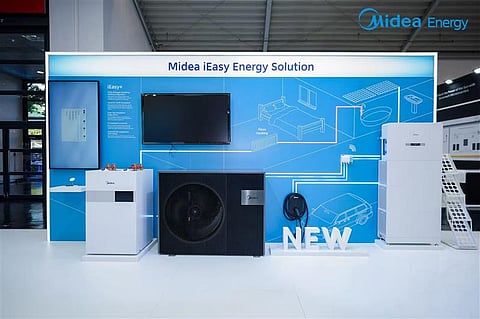


Energy storage and electrical equipment provider Midea Hiconics has unveiled a private placement plan to raise up to RMB 1.652 billion from its controlling shareholder, Midea Group. The company said the proceeds will support projects in the new energy and electrical equipment sectors, including capacity expansion and technology upgrades, as it shifts from PV power plant development toward smart energy operations.
The investment plan allocates RMB 437 million to the R&D and industrialization of PV grid-connected inverters for residential, commercial & industrial (C&I), and utility-scale applications. Another RMB 292 million will be directed toward residential energy storage systems, while RMB 184 million will support distributed PV demonstration projects and R&D systems for rural and industrial rooftops. The remaining funds will be used for a high-voltage variable frequency drive project and general working capital.
In an exclusive interview at SNEC 2026, Gerry Liu, General Manager of Hiconics Overseas Platform, detailed the company’s strategy on integrating home appliances with ESS (see Midea Group’s Hiconics Bets On Appliance-ESS Integration). TaiyangNews also covered the company’s exhibits at SNEC and Intersolar Europe 2026.
The National Energy Administration (NEA) has reported that China added 71.77 GW of new grid-connected solar capacity in the first half of 2026, down 66.1% year-on-year. Distributed solar accounted for 42.22 GW, down 62.6% and representing 58.8% of total additions, while centralized PV contributed 29.55 GW, down 70.1%. Within the distributed segment, residential and C&I PV additions reached 21.83 GW and 20.39 GW, respectively.
By the end of June 2026, China’s cumulative grid-connected solar capacity reached 1,271.99 GW, including 696.23 GW of centralized plants and 575.76 GW of distributed systems. Jiangsu led new installations with 8.61 GW, while Yunnan recorded the largest centralized PV additions at 6.70 GW, and Henan led distributed PV additions at 7.58 GW.
A note here: the NEA’s numbers are slightly different from those reported by the CPIA recently. The NEA attributes this variance to a few project exits and a change in methodology.
Huawei Digital Power’s SUN2000-506KTL series inverters, with the domestic model designated SUN2000-460KTL, has received Grid-Forming (GFM) capability certification from TÜV SÜD. According to Huawei, it is the first certification completed under the latest VDE FNN V2.1:2026 quantitative standard.
The certification verifies 5 technical capabilities, including voltage-source characteristics, inertia support, primary frequency regulation precision, and natural response under extreme grid disturbances. These capabilities were validated on an ultra-low-SCR weak-grid test platform using real impedance.
Late last month, Huawei Digital Power’s LUNA2000 S1 residential ESS received TÜV Rheinland's Safety Mark Level 3 (Prime) certification (see China Solar PV News Snippets).
Chinese energy developer China Resources Power (CR Power) has announced the shortlisted candidates for its 5.4 GW centralized procurement of n-type bifacial double-glass TOPCon modules. Scheduled for delivery from August 2026 to July 2027, the tender saw bid prices fall as low as RMB 0.663/W.
The first lot covers 3 GW of modules rated at a minimum of 620 Wp, with GCL SI, JA, DMEGC Solar, and Huayao PV among the shortlisted bidders, submitting prices ranging from RMB 0.663/W to RMB 0.692/W. The second lot covers 2 GW of modules rated at 710 Wp or higher, with the same group of suppliers bidding between RMB 0.672/W and RMB 0.705/W. The final 0.4 GW lot covers modules rated at 725 Wp or higher, with JA, Huayao PV, and DMEGC Solar submitting bids ranging from RMB 0.696/W to RMB 0.712/W.
CR Power launched this tender in June (see China Solar PV News Snippets).
China’s polysilicon market has seen no price quotations or transactions for 2 consecutive weeks as producers undergo a ‘price reconstruction’ phase. According to the Silicon Industry Branch of the China Nonferrous Metals Industry Association, the market is currently in a wait-and-see period following industry self-regulation, with participants awaiting a new market consensus.
The situation follows price compliance guidance issued by the State Administration for Market Regulation in late July, after which eight major polysilicon manufacturers signed a binding self-regulation agreement committing not to sell products below cost and to phase out energy-intensive capacity (see Eight Chinese Polysilicon Makers Agree To Fair Pricing).
China produced 105,100 tons of polysilicon in July, while wafer output reached 55.26 GW, according to the association. Polysilicon inventories increased by 9,600 tons during the month, including imports and exports, reaching approximately 522,000 tons at the end of July.
