

China's solar manufacturing output and new PV installations declined across all major supply chain segments during H1 2026, says CPIA
Despite the domestic slowdown, export value increased due to growing overseas manufacturing and demand from international markets
CPIA expects the global market to recover after a temporary slowdown, with policy support and solar-plus-storage driving long-term growth
China's solar PV industry underwent a significant adjustment during H1 2026, with manufacturing output and domestic installations declining sharply even as exports continued to grow, according to a report released by the China Photovoltaic Industry Association (CPIA).
The report said output declined across all major segments of the PV supply chain. Between January and June 2026, China produced 538,000 metric tons of polysilicon, 293 GW of wafers, 260.7 GW of solar cells, and 201.3 GW of modules. Compared with the same period last year, polysilicon output fell by 9.8%, wafers by 7.3%, cells by 21.9%, and modules by 35.1%.
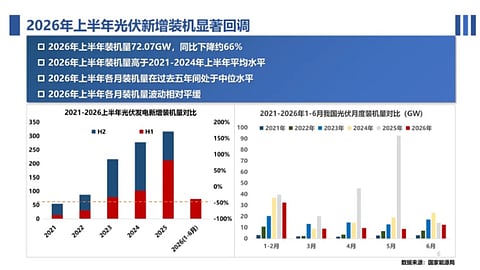
China installed 72.07 GW AC of new solar PV capacity during the six-month period, representing a 66% year-on-year (YoY) decline. However, CPIA's Bohua Wang noted that installations remained above the average first-half level recorded between 2021 and 2024. Solar additions in H1 2025 totaled 197.85 GW AC, mainly due to over 92 GW AC installed in May to meet the June 1 deadline of FIT expiration (see China’s June 2025 Solar PV Additions Fall To 14.36 GW).
Despite weaker domestic demand, the country's PV exports remained resilient. Total export value rose 24.3% YoY to $17.18 billion, supported by higher overseas demand for cells and wafers as solar manufacturing capacity expanded outside China.
Indonesia became the largest destination for Chinese cell exports, while India emerged as the biggest market for wafer exports. Europe continued to be a major destination for modules, with Southeast Asia and Africa also contributing to overseas demand.
The association also highlighted continued pressure on manufacturers as prices for polysilicon, wafers, and cells declined during the reporting period, while module prices increased slightly. Companies also faced weaker profitability, lower revenues, longer payment cycles, and reduced financing capacity.
On the policy front, CPIA said China continued to strengthen its PV manufacturing framework through measures focused on product quality, green manufacturing, and digitalization. New regulations also addressed module safety, energy efficiency, renewable electricity use, AI-enabled manufacturing, and industrial decarbonization.
At the same time, the report pointed to rising global trade barriers, including US tariffs and investigations, European sustainability regulations, and India's import restrictions.
Looking ahead, CPIA reiterated its stance that global solar installations will experience a temporary slowdown in 2026 before returning to growth in 2027 and beyond. Under the medium-case scenario, the association shares SolarPower Europe's forecast of around 612 GW DC of new PV installations worldwide in 2026, driven by the impact of Chinese policy, representing a YoY decline from around 664 GW DC installed in 2025. Growth will pick up after this temporary slowdown and annual installations will reach 864 GW by 2030 (see Global Solar PV Installs Hit 664 GW In 2025; 8% Drop Ahead).
It said long-term growth will be supported by China's new energy system, greater focus on energy security, rising demand for green electricity, and improving competitiveness of solar-plus-storage projects.
Wind and solar are central to China's renewable energy targets under the 15th Five-Year Plan, with a combined capacity of 2.8 TW AC by 2030 (see China Targets 2.8 TW AC Solar & Wind In 15th Five-Year Plan).
