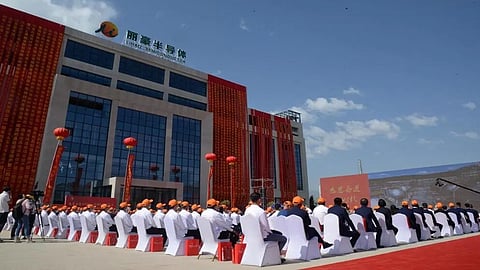


Vertically integrated PV manufacturer Tongwei Co., Ltd., announced plans to acquire 100% equity in Qinghai Lihao Clean Energy Co., Ltd., a polysilicon manufacturer. The company has signed a letter of intent and plans to fund the transaction through a combination of share issuance and cash payment, alongside raising matching funds. Transaction value and detailed terms have not yet been disclosed.
Established in 2021, Lihao focuses on high-purity crystalline silicon and electronic-grade polysilicon. According to its website, the company has planned solar-grade polysilicon capacity of 200,000 MT in Qinghai and a further 200,000 MT in Sichuan.
According to Tongwei’s FY2025 financial results forecast released last month, the company expects its adjusted net loss to widen by RMB 2.0 billion to RMB 3.0 billion year-over-year to RMB 9.0 billion to RMB 10.0 billion (see China Solar PV News Snippets).
China Huaneng Group announced the winners of its 4 GW inverter procurement, covering Sections 1 and 3 of a larger 10 GW tender launched in January (see China Solar PV News Snippets).
Section 1, comprising 1 GW of centralized inverters, was awarded to TBEA and Sungrow at RMB 0.083/W and RMB 0.09/W, respectively. Section 3, covering 3 GW of high-power string inverters, was awarded to Beijing Keyvia and Sungrow at RMB 0.103/W and RMB 0.095/W, respectively.
Solar cell manufacturer SJEF Solar signed a cooperation agreement with Oriental Tiansuan Technology, a Joint Laboratory for Space Computing, to jointly develop and launch a satellite to test solar cell performance in space. Oriental Tiansuan will oversee satellite development and launch control, while SJEF Solar will supply the primary and final flight model TOPCon cells.
The satellite will carry 2 panels of TOPCon crystalline silicon cells. Factory review is scheduled for completion in the first half of the year, with on-orbit testing expected to conclude within 3 months following launch.
State Power Investment Corporation (SPIC) has initiated a system-wide inspection and rectification campaign targeting distributed PV assets. Led by its smart energy subsidiary, the program covers approximately 5 GW of installed capacity across nearly 190,000 households in 22 provinces.
The review focuses on issues including communication failures, low system efficiency, and prolonged outages. Using digital O&M platforms alongside on-site inspections, the campaign aims to conduct list-based audits and implement corrective actions to improve asset reliability and operational performance.
The Hunan Provincial Development and Reform Commission has issued implementation rules for distributed PV development, classifying projects into 4 categories: residential (≤380V); non-natural person/non-residential (≤10kV, ≤6MW); general C&I (≤10kV, ≤6MW); and large-scale C&I (35kV/20MW or 110kV/50MW).
For general C&I projects operating under a self-consumption with surplus-to-grid model, the annual self-consumption rate must be at least 50%, with public institutions such as government agencies, schools, and hospitals exempt. Large-scale C&I projects participating in the spot market must maintain a minimum self-consumption rate of 80%.
