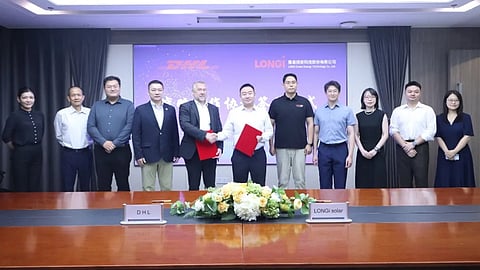


Leading vertically integrated PV manufacturer LONGi has signed a strategic memorandum of understanding (MoU) with logistics giant DHL Group to jointly develop global solar and energy storage markets. The partnership combines LONGi's high-efficiency PV, battery energy storage system (BESS), and green hydrogen technologies with DHL's global logistics network to support the decarbonization of logistics infrastructure.
Under the agreement, the companies will deploy LONGi's building-integrated photovoltaics (BIPV) across DHL's logistics parks and office facilities in Europe while jointly developing integrated PV-plus-storage solutions for logistics hubs. DHL will also serve as a testing platform for LONGi's latest solar and storage technologies, supported by a regular communication mechanism to coordinate project implementation.
On the financial performance side, LONGi recently revealed that it expects an adjusted net loss of RMB 3.7 billion and RMB 4.2 billion for H1 2026 (see China Solar PV News Snippets).
China's Ministry of Commerce (MOFCOM) has released a position paper on the ‘so-called excess capacity’ issue, stating that global capacity changes reflect international industrial division and market cycles rather than permanent overcapacity.
The ministry said export growth in industries such as photovoltaics, new energy vehicles, and lithium-ion batteries has been driven by economies of scale, technological innovation, and growing global demand for clean energy. It added that the competitiveness of China's new energy industries stems from long-term R&D investment and technological progress rather than government subsidies.
MOFCOM also called for greater international cooperation on industrial and supply chains, urging countries to respect market rules and reduce trade barriers. Separately, ministry official Weilong Lin said the U.S. Section 301 investigation into overcapacity was a unilateral action and urged the U.S. to resolve differences through dialogue and consultation.
Perovskite solar manufacturer SolaEon said its crowdfunding campaign for a perovskite-powered smart lock has exceeded $500,000 on Kickstarter.
Developed with a subsidiary of smart-lock manufacturer Dessmann, the DESLOC V150 Plus integrates a 4.8-inch perovskite module capable of charging under ambient light as low as 300 lux. The company said the module delivers around six times the power generation efficiency of crystalline silicon under low-light conditions and added that it now supplies perovskite power solutions to brands including Lenovo, Anker Innovations, and Midea Group for smart locks, security cameras, and other IoT devices.
A research team led by Jilin Hesheng Technology, in collaboration with Jilin University and several aerospace institutes, has completed what it calls the world's first in-orbit verification of perovskite X/γ-ray detectors.
Launched aboard the Gande-1 01 satellite on July 24, the payload integrates perovskite radiation detectors with perovskite solar cell testing modules. According to local media, the mission verified the performance of both technologies in the space environment after completing vibration and thermal vacuum qualification tests before launch. The research team plans to continue orbital testing to support future applications in medical imaging and industrial inspection.
State-owned energy developer SPIC has exported 3,750 tons of green ammonia to South Korea, which the company said is the world's largest single-batch shipment of green ammonia.
The cargo was produced at the HYGLOBAL Da'an Green Hydrogen-Ammonia Integration Demonstration Project, which began operating in July 2024 with 800 MW of renewable energy capacity. The project targets an annual production of 32,000 tons of green hydrogen and 180,000 tons of green ammonia using an integrated renewable power-to-hydrogen-to-ammonia process featuring electrolysis equipment from LONGi and Sungrow.
SPIC said the facility has obtained ISCC EU certification under the EU RED III framework and that the shipment is expected to reduce lifecycle carbon dioxide emissions by more than 10,000 tons.
