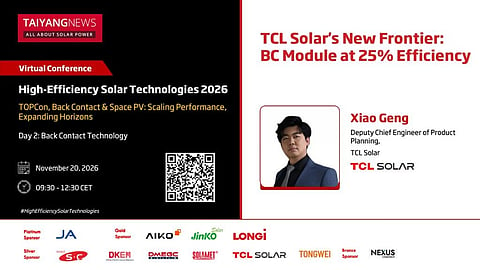


Day 1 of the TaiyangNews High-Efficiency Solar Technologies 2026 Online Conference focused on dual-sided contacting technologies. The annual flagship conference continues on Day 2, turning its focus to back-contact technologies.
Xiao Geng, Deputy Chief Engineer of Product Planning at TCL Solar, will discuss the company’s BC story in a presentation titled TCL Solar’s New Frontier: BC Module at 25% Efficiency. Day 2 is scheduled for Friday, November 20, 2026, from 09:30 to 12:30 CET.
If you haven’t yet, registration is open and free here.
China’s National Energy Administration (NEA) has released provincial-level PV construction data for the first three quarters of 2026. The data shows 110.33 GW of newly grid-connected capacity nationwide through this period.
Broken into its constituents, centralized PV accounted for 45.81 GW, and distributed PV accounted for 64.52 GW, including 33.46 GW of residential PV and 31.06 GW of commercial and industrial (C&I) capacity.
Provincially, Jiangsu led with 12.79 GW of additions, followed by Henan with 10.53 GW and Yunnan with 9.08 GW, though the three followed distinctly different paths. Henan’s additions were entirely distributed, including 9.10 GW of residential PV, whereas centralized capacity accounted for 87.9% of Yunnan’s total. Jiangsu’s growth was more evenly split between centralized and distributed installations.
As of the end of September, China’s cumulative grid-connected PV capacity reached 1,310.55 GW, comprising 711.90 GW of centralized PV and 598.65 GW of distributed PV, with C&I accounting for roughly 59% and residential PV about 41% (see China Adds 110.83 GW AC Solar In 9M 2026, Down 54% YoY).
The Fujian Provincial People’s Government has issued its energy development plan for the 15th Five-Year Plan period (2026-2030), targeting total provincial power capacity of more than 140 GW by 2030. Under the plan, clean energy is set to account for over 68% of installed capacity, and non-fossil sources are set to supply more than 50% of electricity generation. Fujian aims to add at least 12 GW of solar capacity and 5 GW of pumped hydro storage while meeting all incremental electricity demand with new clean generation.
On energy storage, Fujian targets at least 1 GW of grid-side independent new-type energy storage capable of providing peak-load support, with an equivalent peak-support duration of four hours. The plan also calls for scaled deployment of fishery-solar hybrids, offshore wind-solar co-location, building-integrated PV (BIPV), PV-storage-direct-flexible systems, and integrated PV-storage-charging-swapping facilities, alongside the gradual establishment of a reliable capacity compensation mechanism.
China Petrochemical Corporation (Sinopec) has started construction on its Ulanqab green hydrogen and hydrogen pipeline project. The company said it is set to be China’s first large-scale, long-distance pure hydrogen transmission project across provincial-level regions, covering production, storage, transport, and end use. Construction was initially planned to start in June 2026 (see China Solar PV News Snippets).
To be built in two phases, Phase I of the project is designed to produce 100,000 tonnes of hydrogen per year, and Phase II 200,000 tonnes per year. Phase I includes 2.45 GW of supporting wind and solar capacity, about 1 GW of total electrolyzer capacity, and an 805 km hydrogen pipeline with an initial transmission capacity of 300,000 tonnes per year, rising to 500,000 tonnes per year in Phase II.
Originating in Ulanqab, Inner Mongolia, the pipeline will supply green hydrogen directly to Yanshan Petrochemical and Tianjin Petrochemical to replace existing grey hydrogen capacity, while also supporting natural gas blending, hydrogen metallurgy, hydrogen transport, and international green hydrogen trade.
State-owned power engineering and construction group China Energy Engineering Corporation (Energy China/CEEC) has issued a procurement tender for a 370 MW/1,480 MWh battery energy storage system (BESS). The equipment will serve the company’s new energy base in the coal-mining subsidence area of Xinrong, Shanxi Province, which is divided into two blocks: 250 MW/1,000 MWh at Xinrong South and 120 MW/480 MWh at Xinrong North.
Energy China recently released the list of proposed awardees for its 2026 centralized PV module procurement tender for about 15 GW (see China Solar PV News Snippets).