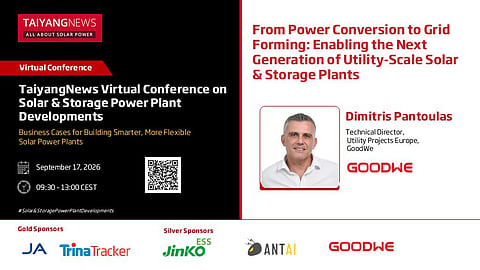


As solar penetration rises, project developers are facing tighter grid availability, curtailment, and pressure on project economics, making flexibility and smarter plant design increasingly important. The TaiyangNews Virtual Conference on Solar & Storage Power Plant Developments will bring together developers, EPCs, procurement managers, and technology suppliers to discuss how battery storage, advanced trackers, high-power modules, hybrid generation, and other plant-level technologies are shaping the next generation of utility-scale solar projects.
Dimitris Pantoulas, Technical Director, Utility Projects Europe at GoodWe, will be speaking on the topic From Power Conversion to Grid Forming: Enabling the Next Generation of Utility-Scale Solar & Storage Plants at the TaiyangNews Solar & Storage Power Plant Developments Virtual Conference.
The conference is scheduled from 09:30 to 13:00 CEST on Thursday, September 17, 2026. Register for free here.
Jinko ESS, the energy storage subsidiary of JinkoSolar, announced that its factory in Haining, Zhejiang, passed zero-carbon factory verification by TÜV Rheinland and received a Type I Three-Star rating under the T/CECA-G 0171-2025 standard. The facility achieved 100% renewable electricity consumption during the reporting period through on-site solar generation, green power trading, and green certificates.
The factory has installed a 12 MW distributed rooftop PV system covering 66.44% of its total roof area. In 2025, self-generated solar power supplied 18.97% of the factory’s total electricity consumption. Its Scope 1 and Scope 2 greenhouse gas emissions totaled 26,133.63 metric tons of CO₂ equivalent during the year, of which 13,068 metric tons, or 50%, were offset.
Jinko ESS recently deployed nine units of its SunGiga G2 261 kWh C&I ESS at Changzhou International Enterprise Port in Jiangsu Province (see China Solar PV News Snippets).
PV and ESS manufacturer Risen Energy has expanded into integrated computing and power solutions, launching a new business targeting green computing services. The company has introduced an integrated solution covering power generation, energy storage, intelligent dispatch, and project delivery, designed to address the high energy consumption of intelligent computing centers and mismatches between intermittent renewable generation and computing loads.
Risen Energy said its HJT Hyper-ion modules provide renewable electricity, while its fully liquid-cooled silicon carbide (SiC) energy storage system helps smooth load fluctuations. At the dispatch level, the Risen Cloud platform and Energy OS use AI to coordinate solar generation, energy storage, and computing resources. For project delivery, the company provides full-cycle EPC and O&M services covering solar and storage facilities and data-center power distribution systems. It is also expanding into computing-capacity leasing and equipment for integrated computing-power applications.
Perovskite PV developer RenShine Solar has achieved a certified power conversion efficiency of 26.4% for a large-area all-perovskite tandem module. TÜV SÜD certified the result over an aperture area of 809 cm², which the company said sets a new world record for tandem modules of this size.
The result was achieved using RenShine Solar’s first 10 MW all-perovskite tandem pilot line. The company previously achieved a certified efficiency of 26.2% on a 65 cm² module, while its 30 cm × 40 cm module with an efficiency of 22.8% was included in NREL’s Champion Module Efficiencies chart. RenShine Solar is now advancing industrial application validation of the technology for space PV and high-efficiency terrestrial energy systems.
Last month, RenShine announced achieving a certified efficiency of 22.0% on a 1.2 × 0.6 m commercial-scale perovskite module with a total area of 0.72 m² (see China Solar PV News Snippets).
Integrated PV manufacturer Tongwei Co., Ltd. has secured antitrust clearance for its planned acquisition of 100% of Qinghai Lihao Clean Energy Co., Ltd., along with associated fundraising. The company said it has completed preliminary audit and valuation work, and China’s State Administration for Market Regulation has issued a decision not to prohibit the transaction.
Significant changes in PV market conditions since the transaction plan was announced have left the parties divided over specific deal terms. Tongwei expects it will be unable to issue notice of a shareholders’ meeting within 6 months of the initial board resolution, or by September 10, 2026. The company said it will continue pursuing the acquisition and, once it reaches an agreement on the transaction plan, will reconvene its board to review the plan and re-determine the share issuance price. Lihao Clean Energy remained loss-making in both 2024 and 2025 amid continued supply-demand imbalances in the PV industry.
PV laser equipment manufacturer DR Laser reported revenue of RMB 1.029 billion for the first half of 2026, down 12.02% year-on-year, including RMB 950 million from laser equipment for PV cells and modules. Net profit attributable to shareholders fell 6.38% to RMB 306 million, while net profit excluding non-recurring items declined 14.16% to RMB 271 million. DR Laser attributed the weaker results mainly to near-term volatility in the PV industry, customer capital expenditure, and the timing of equipment deliveries and revenue recognition.
The company said in a July investor briefing that its PV laser equipment orders in 2026 were mainly for BC and TOPCon cell technologies. It is advancing BC laser micro-etching and electroplating patterning equipment, as well as laser selective thinning and laser sintering equipment for TOPCon. On the module side, DR Laser is developing LIB (Laser Integration Bonding) technology for one-step full-area metallization welding and integrated MBI (Metal Backsheet Interconnection) equipment for BC modules used in distributed PV applications.
