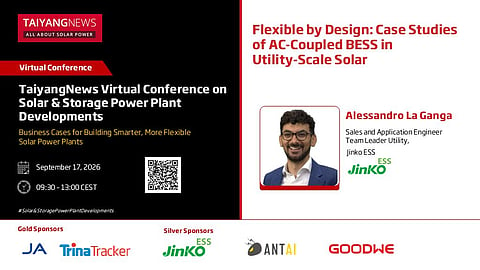


As solar penetration rises, project developers are facing tighter grid availability, curtailment, and pressure on project economics, making flexibility and smarter plant design increasingly important. The TaiyangNews Virtual Conference on Solar & Storage Power Plant Developments, taking place on Thursday, September 17, 2026, will bring together developers, EPCs, procurement managers, and technology suppliers to discuss how battery storage, advanced trackers, high-power modules, hybrid generation, and other plant-level technologies are shaping the next generation of utility-scale solar projects.
Alessandro La Ganga, Sales and Application Engineer Team Leader, Utility, at Jinko ESS, will discuss case studies of AC-coupled BESS in utility-scale solar to help build smarter, more flexible solar power plants.
The conference is scheduled from 09:30 to 13:00 CEST. Register for free here.
PV module manufacturer Astronergy served as a core module supplier for China Datang’s 300 MW Yiqing solar-grazing PV project in Basu County, Tibet, supplying 157 MW of its ASTRO N8 n-type TOPCon modules. Located in Chamdo at an elevation of more than 4,400 meters, the project has achieved full-capacity grid-connected operation and is expected to generate an average of 520 million kWh annually.
According to Astronergy, the modules are designed for high-altitude, cold-weather, and grazing applications and can withstand temperatures from -40°C to +85°C. The project uses a customized mounting configuration with a 2 m leading-edge height and a 4 m trailing-edge height, designed to maintain power generation performance while providing sufficient grazing space beneath the PV arrays.
Power equipment manufacturer TBEA has completed production of its independently developed SFFZ-300000/400 large-capacity double-split winding main transformer. Rated at 300 MVA, the 3-phase, oil-immersed, forced-air-cooled transformer features two independent 150 MVA branches on the low-voltage side, allowing simultaneous connection to two 35 kV renewable energy collection systems. This enables separate power supply zones and limits short-circuit currents.
The transformer has an on-load tap-changing range of 400±15×1.25%, covering an operating range of 325 kV to 475 kV. It can continuously regulate voltage under load to respond to large voltage fluctuations associated with renewable power generation and improve grid integration stability.
TBEA said the transformer will serve Masdar’s round-the-clock solar-storage development in Abu Dhabi, described as the world’s first gigascale round-the-clock solar-plus-storage project and the largest combined solar and battery energy storage system (BESS) project announced to date.
Energy China’s Anhui Electric Power Design Institute has won the bid for a 200 MW/1,200 MWh grid-forming standalone energy storage project in Shache County, Kashgar, Xinjiang. The project has been described as southern Xinjiang’s first grid-forming new-type energy storage demonstration project, with 6 hours of continuous discharge capability. It will deploy a 200 MW/1,200 MWh lithium iron phosphate BESS and a 220 kV step-up substation.
The project will use full-capacity grid-forming and long-duration energy storage (LDES) technologies, enabling voltage-source operation, black-start capability, rotational inertia, and voltage and frequency regulation. Designed to address the 6-9 hours of surplus solar generation that can occur during the daytime in southern Xinjiang, the system is expected to accommodate an additional 110 million kWh of otherwise-curtailed solar generation annually. It will connect to the Kashgar grid and support high renewable penetration at the region’s clean energy base.
Energy China recently issued a RMB 2.5 billion green, technology-innovation, and climate-themed perpetual corporate bond on the Shanghai Stock Exchange (see China Solar PV News Snippets).
PV module manufacturers GPSOLAR and Ronma Solar have won the third and fourth packages of the second-phase module procurement for a 1 GW solar-plus-grassland PV project in Manas, Xinjiang. The two packages total 637.36 MW and require monocrystalline bifacial dual-glass n-type modules rated at 720 Wp or above.
Each package covers 318.68 MW. GPSOLAR secured the third package at RMB 0.716/W, while Ronma Solar won the fourth at RMB 0.718/W. The modules will be used for the 1 GW Manas PV project, which has a planned DC-side capacity of 1,069.36 MWp.
PV conductive paste manufacturer Fusion Materials reported revenue of RMB 10.60 billion for the first half of 2026, up 64.75% year-on-year. The company reported a net loss attributable to shareholders of RMB 86.49 million, compared to a profit of RMB 181 million a year earlier, while net profit excluding non-recurring items fell 38.37% to RMB 96.31 million.
Fusion said the sharp revenue increase was mainly driven by higher average silver prices. At the same time, significant volatility in silver prices led to higher inventory write-down provisions and unrealized losses on derivatives positions, while the cancellation of export tax rebates also weighed on profitability.
The company sold 636 metric tons of PV conductive paste during the period, generating RMB 10.398 billion in revenue, equivalent to about 98% of total revenue. Its PV silver paste portfolio covers TOPCon, HJT, and xBC cell technologies. Fusion is also continuing to develop silver-nickel, silver-coated copper, and pure copper pastes as part of its efforts to reduce or eliminate silver use.
For FY2025, Fusion Materials reported revenue of RMB 14.593 billion (see China Solar PV News Snippets).
