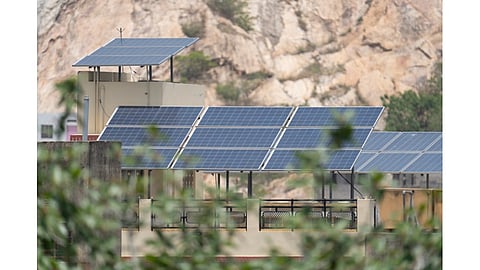


India is considering mandating locally manufactured inverters and batteries under the next phase of PM Surya Ghar
The next phase is expected to follow the current scheme, which is scheduled to end on March 31, 2027
Earlier, MNRE mandated India-based data storage and daily generation-data sharing for inverters used under PM Surya Ghar
India is considering mandating domestically manufactured solar inverters and batteries under the next phase of its flagship rooftop solar scheme, the PM Surya Ghar Muft Bijli Yojana (PMSGMBY or PM Surya Ghar).
The proposal could also include domestic content requirements for batteries, according to a Mint report citing Renewable Energy Secretary Santosh Kumar Sarangi, who said the proposals remain under consideration.
India introduced the PM Surya Ghar scheme in February 2024 with a total outlay of INR 750 billion to provide up to 300 units of free electricity/month to 10 million households. The target is to achieve 30 GW of installed rooftop solar capacity (see India Eyeing 30 GW Rooftop Solar Capacity With New Scheme).
According to the Ministry of New and Renewable Energy (MNRE), a total of 14.8 GW rooftop solar capacity had been commissioned as of August 4, 2026, under PM Surya Ghar scheme.
Solar modules used under PM Surya Ghar are subject to the Approved List of Models and Manufacturers (ALMM) List-I requirements, while solar cells must comply with ALMM List-II, subject to applicable exemptions. Residential net-metering consumers who opt out of government subsidies under the ‘Give It Up’ campaign are exempt from the List-II requirement until March 31, 2027, the scheme’s scheduled end date (see MNRE Clarifies ALMM List-II Exemption For PM Surya Ghar Users).
The proposed requirements would extend domestic sourcing rules beyond the solar cells and modules currently covered by the ALMM framework and Domestic Content Requirement (DCR). Inverters and batteries are not currently covered by equivalent ALMM lists, meaning the government may need to introduce separate localization criteria for these products.
India has significantly expanded its domestic solar manufacturing capacity through measures including the Production Linked Incentive (PLI) scheme and ALMM requirements, alongside tariffs on imported products. According to Mercom India Research, cumulative solar PV module manufacturing capacity reached 261.7 GW in June 2026, while solar cell capacity stood at 36.6 GW (see India Adds 50.6 GW Solar Module Capacity In 1H 2026).
The proposed localization requirements would extend India’s domestic manufacturing push to rooftop solar inverters and batteries. Domestic inverter manufacturing is already expanding ahead of the proposed move, with Waaree Power Private Limited recently announcing plans to increase its annual inverter manufacturing capacity to 4.15 GW (see Waaree Power Expands Solar Inverter Manufacturing Capacity).
India’s battery-cell manufacturing capacity, however, remains limited relative to its projected needs. According to Wood Mackenzie, the country had just 2 GWh of commissioned battery-cell manufacturing capacity in 2026, equivalent to less than 1% of its approximately 260 GWh demand pipeline from competitive tenders that year. The research firm estimates that India remains 10 to 15 years away from achieving a globally competitive, self-sufficient battery-cell industry (see Wood Mackenzie: India’s Battery Self-Sufficiency 10 Years Away).
Despite the expansion of domestic manufacturing, gaps remain in India’s solar and battery supply chains. The proposed inverter and battery requirements are still under consideration, with Sarangi saying the ministry is evaluating recommendations from various stakeholders as it considers ways to strengthen domestic manufacturing across the value chain. He did not specify what support the government might provide to manufacturers.
Separately, in August 2026, MNRE directed inverter manufacturers supplying systems under PM Surya Ghar to store inverter-level data on servers in India and share daily generation data with the National Portal through a standard application programing interface, to ensure data security.
TaiyangNews will host the 3rd TaiyangNews Solar Technology Conference India (STCI 2027) on January 20-21, 2027, at New Delhi which will bring together leading solar manufacturers, upstream technology suppliers, and quality experts to delve into the evolving landscape of Indian PV manufacturing. Registrations will open soon here.
