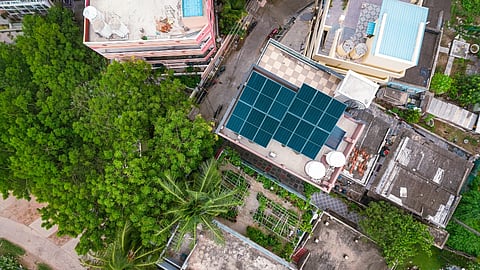


Sri Lanka recently experienced a nationwide blackout, prompting the NSO to ask rooftop solar PV system owners to disconnect their installations
Rising rooftop solar generation has highlighted the need for greater grid flexibility and energy storage to maintain a stable electricity supply
Sri Lanka’s regulator has previously flagged gaps in real-time rooftop solar monitoring and inverter protection settings
Sri Lanka’s recent nationwide power outage has highlighted the challenges of integrating growing amounts of solar power into the grid. It has also renewed calls for investment in grid flexibility, system controls and energy storage.
On October 17, 2026, Sri Lanka’s National System Operator (NSO) reportedly asked rooftop solar PV system owners to disconnect their installations until further notice to support efforts to restore the electricity supply. The outage affected the entire island, with power restoration taking several hours.
According to local media reports, the NSO attributed the nationwide blackout to instability in the transmission network.
Sri Lanka’s Energy Minister Aruna Karunathilaka subsequently told Parliament that a coal-fired generating unit at the Norochcholai power plant had tripped during maintenance, triggering a sharp decline in grid frequency.
According to the minister’s account, the grid was managing 1,137 MW from controlled generation sources, including coal and hydropower, alongside around 1,700 MW of ‘unmonitored’ capacity, largely solar generation. The sudden loss of generating capacity reportedly caused renewable sources to disconnect faster than conventional power plants could compensate, contributing to the system’s collapse. The findings remain subject to the official investigation.
The NSO followed up with plans to implement one-hour power cuts across the four national zones for three days, starting October 19, 2026.
However, the incident has drawn attention to the technical challenges of managing the growing volume of distributed solar generation.
Previously, Sri Lanka had faced a nationwide blackout in February 2025. The Public Utilities Commission of Sri Lanka (PUCSL) pointed to the high penetration of rooftop solar PV systems and low daytime demand as contributing factors to the system imbalance that led to the blackout.
In its March 2026 report, Analysis on Rooftop Solar Integration & Industry Growth in Sri Lanka, the regulator highlighted challenges due to lack of real-time monitoring and visibility of rooftop solar PV systems at the national system control level. This was leading to a duck curve. It recommended updated inverter protection settings, among other measures, to enable rooftop PV systems to remain connected during certain grid disturbances rather than disconnecting immediately.
The regulator identified several barriers to implementation, including older inverters that lack the required capabilities, unsupported firmware updates, and limited enforcement of the revised requirements.
These challenges extend beyond Sri Lanka, particularly in emerging markets where rooftop solar is expanding rapidly, and grid flexibility, monitoring, and storage infrastructure may not be keeping pace. The experience of other markets highlights the need to address these issues alongside solar deployment.
In Pakistan, rapid rooftop solar adoption has increased interest in battery storage and decentralized electricity-sharing systems (see PRIED: Pakistan Could Use Rooftop Solar To Build Swarm Grids). In India, grid constraints have contributed to solar power curtailment despite strong electricity demand (see India Curtails 1.46 Billion Units Of Solar Power In 2 Months).
