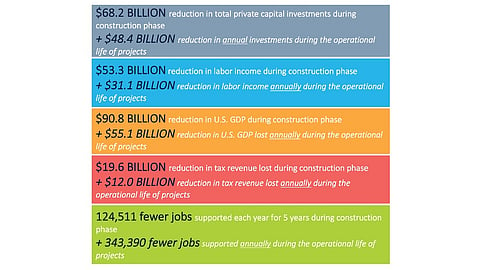


An E2 analysis estimates that 216 clean energy projects canceled, closed, or downsized since January 2025 represent $68.2 billion in lost capital investment
The affected projects include about 20 GW of planned solar, wind, and battery storage capacity, enough to power roughly 3 million homes
Analysts expect these cancellations to have impacted around 468,000 jobs, including approximately 343,500 long-term operational jobs
A new analysis by US business group E2 estimates that the cancellation, closure, and downsizing of 216 large-scale clean energy projects, including solar and storage, since January 2025 have cost the US economy around $68 billion in private investment and nearly 470,000 jobs.
The report estimates the losses for clean energy project cancellations between January 1, 2025, and May 2026 across solar, wind, electric vehicles (EVs), electricity transmission & distribution (Electric T&D), battery storage, and clean fuels. At $24.15 billion, battery storage alone accounts for 35% of the total lost capital investment, followed by solar at $16.71 billion or 25%.
The cancellations have also wiped out an estimated $48.4 billion in annual operational spending. During construction, the projects were expected to contribute $90.8 billion to US GDP, followed by another $55.1 billion in annual GDP once operational.
Other losses include nearly $20 billion in tax revenue from construction and $12 billion annually from operations.
The study attributes the setbacks to federal policy changes affecting clean energy incentives and development, especially the One Big Beautiful Bill Act (OBBBA).
Moreover, the analysts highlight that the impacts of the OBBBA have been compounded by the Trump administration’s broader ‘hostility’ to clean energy, including restrictions on solar and wind permitting, financial settlements to halt offshore wind projects, and cuts to federal clean energy programs, further increasing the law’s economic costs.
It models direct, indirect, and induced economic impacts of the cancellations, including effects on supply chain businesses and local spending that could have supported these investments.
“The losses go far beyond the direct jobs announced by companies. Every cancelled factory or power project means fewer construction workers on site, fewer suppliers filling orders, fewer dollars flowing through local economies, and fewer tax revenues for schools, fire departments, roads, and public services,” said E2 Director of Research and Publications, Michael Timberlake.
The canceled or downsized developments include about 10 GW of solar, 3.75 GW of wind, and 9 GW of battery storage capacity. Together, they would have added roughly 20 GW of new capacity to the US grid, with sufficient solar and wind capacity to supply electricity to around 3 million homes.
Battery storage projects account for the largest share of lost construction jobs, followed by solar and EV projects. During operations, EV manufacturing projects account for the largest share of permanent job losses, according to the report titled One Year Since the One Big Beautiful Bill: An Economic Impact Analysis Of America’s Clean Economy.
The loss of battery storage capacity last year has slowed grid expansion needed to meet rising electricity demand, improve reliability, and support renewable energy integration and power sector decarbonization.
According to the analysis, the projects would have supported about 468,000 jobs, including roughly 124,500 construction jobs and 343,500 long-term operational jobs. The solar sector will support an estimated 32,600 fewer jobs annually over 5 years, whereas battery storage will support 42,365 fewer jobs. In fact, battery storage represents the largest share of foregone capital investment and employment, according to the report.
Workers across these industries are also projected to lose an estimated $53 billion in construction wages and more than $31 billion in annual wages after project completion, according to the analysis.
“The numbers tell the story. Making it harder to build clean energy projects means lost jobs, lost investments, lost electricity supplies and lost local tax revenues,” adds E2 Executive Director Bob Keefe. “Add it all up and it’s clear that federal actions to stop clean energy are costing all of us – consumers, businesses and our national economy – big time.”
According to SEIA and Wood Mackenzie, solar capacity additions in the US are expected to remain largely flat between 2026 and 2031 owing to ongoing policy and structural challenges (see SEIA: US Solar Installations Fall 27% YoY To 7.8 GW In Q1 2026).
In June 2026, Wood Mackenzie said $121 billion of renewable energy investment linked to 92 GW of utility-scale projects is at risk in the US as the projects face higher permitting scrutiny (see US Federal Review Puts 92 GW Renewables At Risk).
