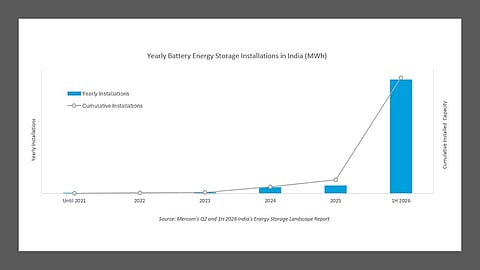


India’s battery storage additions surged in H1 2026, driven largely by several pending utility-scale projects coming online, says Mercom
As of June 2026, Rajasthan, Gujarat, and Maharashtra accounted for more than 60% of India’s cumulative installed storage capacity
Analysts project a strong market going forward, but flag project execution as a key factor
India’s battery energy storage capacity is growing rapidly as utilities increasingly turn to the technology for grid balancing, peak demand management, and renewable energy integration. According to Mercom India Research, the country added 8.2 GWh of battery storage capacity in H1 2026, marking an 84% year-on-year (YoY) increase. This is up from the 98.4 MWh the country installed in H1 2025.
With this, India’s cumulative installed battery energy storage capacity reached 9.3 GWh at the end of June 2026, says Mercom in its Q2 and 1H 2026 India’s Energy Storage Landscape Report.
According to the report, standalone battery energy storage systems (BESS) accounted for 83% of the cumulative capacity at the end of the reporting period, while solar-plus-wind and storage projects offering round-the-clock capabilities represented 9% of the total. Solar-plus-storage projects accounted for another 8%.
Rajasthan led cumulative capacity with a 36% share, followed by Gujarat at 20%, and Maharashtra at 5%. Together, the three states accounted for over 60% of total installed capacity. Mercom points out that states with a high share of renewables are likely to see greater storage deployment, driven by utilities and discoms.
This is not to say, explains Mercom India Managing Director Priya Sanjay, that standalone storage will remain dominant or that this establishes a consistent quarterly trend. In Q2 2026, India’s battery storage additions totaled 3.6 GWh, down 22% quarter-on-quarter (QoQ).
The annual jump in H1 2026 installations was due to several pending utility-scale projects – mostly standalone – coming online after being awarded in competitive auctions. During H1 2026, India tendered a combined 28 GW of battery storage capacity, up 86% YoY from 15 GW in H1 2025. However, the auctioned capacity of 9 GW was 18% lower than 11 GW in H1 2025.
“The need for storage is growing with rising solar additions, higher daytime generation, rising curtailment, and harder-to-meet evening demand,” added Mercom Capital Group CEO Raj Prabhu.
According to Prabhu, the outlook remains strong thanks to a large pipeline which stands at more than eight times current installed capacity. Standalone battery storage represents the largest share of India’s storage pipeline at more than 50%. Solar-plus-storage and solar-plus-wind projects with storage each account for 15%.
Growth could be further supported by a proposed mandate for co-located energy storage in new ground-mounted solar and onshore wind projects commissioned after July 1, 2027 (see India May Mandate Storage For Solar, Wind Projects From 2027).
Prabhu adds that growth will depend on how quickly tendered capacity moves to auctions and awards. Their success will also depend on whether projects have bankable contracts, reliable grid infrastructure, stable supply chains, and workable project economics.
The complete report can be purchased from Mercom’s website.
According to a recent Ember report, solar paired with battery storage could supply up to 90% of India’s electricity demand at a levelized cost of about INR 5.06%, but this would require about 930 GW of solar and 2,560 GWh of battery storage capacity (see Ember: Solar, Storage Could Meet 90% Of India’s Power Demand).
