

According to a new SEIA & Benchmark Mineral Intelligence report US energy storage installations have exceeded 200 GWh
Utility-scale projects accounted for 12.2 GWh of Q3 additions, led by Texas, Arizona, and California
Analysts forecast cumulative installations to reach 708 GWh by 2030
The US energy storage market has crossed 200 GWh of cumulative installed capacity, as battery deployments continue to expand across all segments, as per a new report. The total 215.9 GWh includes 14.3 GWh of new capacity in Q3 2026, taking installations during the first nine months of the year to 48.3 GWh.
The figures are from the U.S. Energy Storage Market Outlook Q4 2026 (ESMO), released by the Solar Energy Industries Association (SEIA) and Benchmark Mineral Intelligence.
According to the report, utility-scale projects accounted for the bulk of Q3 installations, adding 12.2 GWh. Three GW-scale projects came online during the quarter, supporting growth in the utility-scale segment. Commercial and industrial (C&I) storage contributed 1.3 GWh, while residential systems added 746 MWh.
The report said battery energy storage system (BESS) installations in Q3 at 14.3 GWh remained flat quarter-on-quarter (QoQ), but increased 23% year-on-year (YoY) for the first three quarters of 2026.
Overall US installations were up 20% YoY during the January-September period. Texas led utility-scale storage deployment through Q3, adding 12.3 GWh. Arizona followed with 7.7 GWh, while California recorded 6.8 GWh.
The report also highlighted the impact of solar and energy storage deployment on electricity prices. According to SEIA analysis, the growth of these technologies helped reduce average wholesale electricity prices by 42% in Texas and 51% in California between summer 2021 and summer 2026 (see Solar & Storage Cut Wholesale Electricity Prices In CAISO & ERCOT).
Eleven states had already exceeded their previous annual energy storage installation records by the end of Q3, despite three months remaining in 2026. These included Colorado, Massachusetts, Utah, Michigan, Georgia, Mississippi, Virginia, Iowa, Montana, Alabama, and Illinois.
As states move from targets to centralized procurements, Benchmark Minerals Senior Analyst Pete Tillotson says energy storage pipelines are growing across utility mandates and bulk capacity contracts, thanks to “investment appetite and flexibility requirements”.
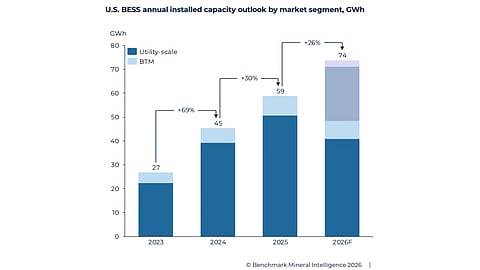
In 2026, analysts project the annual installed BESS capacity of the US to reach 73.8 GWh, up 26% from 59 GWh installed in 2025 which was an increase of 30% over the previous year, comprising both utility and behind-the-meter (BTM) installations. This implies around 26 GWh of new additions in Q4 2026.
SEIA and Benchmark Mineral Intelligence have raised their forecast for cumulative installations by 2030 by 3.7% to 708 GWh across grid-connected and behind-the-meter (BTM) applications. Annual installations are projected to exceed 129 GWh by 2030.
Along with installations, domestic manufacturing is also seeing an uptick as per the report. Ultim Cells of LGES and General Motors began Lithium-ion Phosphate (LFP) commenced cell production for stationary storage in Tennessee in July 2026, while Samsung SDI opened LFP production at its StarPlus Energy facility in Indiana in October. This brought the total US battery cell manufacturing capacity to 92.4 GWh, a 50% increase, according to the report.
Battery module manufacturing capacity exceeded 109 GWh following the opening of an additional facility in Q3. Analysts forecast that LFP will account for 92% of lithium-ion BESS deployments in 2026, up from 77% in 2023. Lithium-ion batteries are expected to account for over 97% of all BESS installations in 2026.
Other technologies, including flow batteries, sodium-ion and lead acid batteries, continue to lag behind lithium-ion. Recently US flow battery and sodium-ion cell manufacturer ESS Tech filed for relief under Chapter 7 (see US Battery Maker ESS Tech Files For Chapter 7 Bankruptcy).
The complete report is available for purchase on Benchmark Mineral Intelligence website.
Meanwhile on the policy front, following the results of the mid-term elections in the US, SEIA said more than 300 solar and storage companies recently urged Congressional leaders to pass the Bipartisan American Affordability and Jobs Act (BAAJA).
The industry says the legislation could accelerate storage deployment, reduce project costs, lower prices, and improve access to affordable electricity.