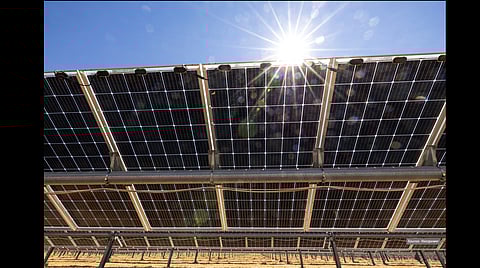


Tracker differentiation is increasingly shifting from mechanical design to software-driven control and optimization
Adaptive algorithms, AI-based decision tools, and improved backtracking strategies help improve energy yield under varying site conditions
Advanced control platforms also enhance system resilience through automated weather-response and predictive stow strategies
In solar trackers, the mechanical hardware provides the structural foundation and physical movement, while the controller acts as the system’s command layer, coordinating motion through advanced tracking algorithms. These technologies enable dynamic adjustment of module positioning throughout the day, responding to changing solar angles and environmental conditions, ultimately improving the energy yield of a solar system.
With significant scope for optimization, software and control algorithms have become the key areas of differentiation for tracker products from different companies. Tracker algorithms are among the most rapidly evolving elements of modern tracking systems. For example, sensor-driven automated weather-response strategies have a proven influence on the overall energy yield. Also, algorithms are shifting from static routines to adaptive and predictive models that respond to site conditions in real time. AI-enabled decision tools, plant-level fleet management, and multi-scenario stow logic are central themes among the leading tracker makers featured in this survey. Each manufacturer uses its own strategy to interpret wind speed, weather data, and diffuse irradiance, which directly influence energy yield. Even for features like terrain following, which largely appear as hardware adaptations, software remains the key to realizing their full value proposition. Features such as backtracking optimization, diffuse-light algorithms, and asset-management integration, which were in the limelight, are still the subject of optimization. A research article illustrates how even established practices, such as backtracking, are being refined. By comparing classical GCR-based backtracking with layout-adapted and terrain-adapted strategies, the study found that layout-specific optimization improved yield during backtracking periods by up to 6%, although the annual impact remained below 1% (see Key Technology Trends In Solar Trackers).
However, the focus is now on smarter and automated decision-making to reduce risk and maximize energy yield. It is also the subject that triggered the highest engagement among the companies that responded to our inquiry for additional input. A recent EU-funded study under the SERENDIPV and CACTUS projects, titled “A Photovoltaic Performance Dataset for Benchmarking of Failure Detection and Diagnosis Algorithms,” highlights that PV degradation effects intensify under low-irradiance conditions. The study observed performance-ratio losses exceeding 20% at irradiance levels below 100 W/m² – operating regimes typical of early morning, late afternoon, winter, and high-latitude conditions.
Emphasizing the importance of advanced algorithms, Anvitha Ravi, senior manager at the global market intelligence division of the world’s largest tracker maker Nextpower, says that trackers are “increasingly software-differentiated. Intelligent software – real-time optimization and control, paired with hardware like independent-row trackers that actively respond to terrain, weather, and shading. This goes beyond just static tracking – it is a dynamic, responsive operation that can squeeze up to 4% more energy from the same footprint.”
“The next, increasingly critical, is system-level resilience. With extreme weather events on the rise, plant owners need infrastructure that can protect itself. We are embedding that capability through features like Hail Pro stowing at 75°, elevated electronics and smart weather-triggered control,” she adds.
Algorithm development is increasingly moving toward AI-assisted decision-making models that can evaluate conditions faster and adjust tracker positioning more dynamically, underscores Ravi. Several tracker manufacturers are implementing these algorithm-driven control concepts through dedicated software platforms. Antaisolar calls its control suite SmartTrail, which features AI-based tracking algorithms, IoT connectivity, and enhanced cybersecurity. Its tracking logic evaluates direct, diffuse, and reflected irradiance. The system also accounts for bifacial operation, temporary shading from passing clouds, and terrain variations. A 3D modeling engine minimizes terrain-induced shading and improves performance on irregular sites. Each control unit can be equipped with multiple types of weather sensors and act as a micro-weather station. Based on the real-time input from this weather station and also AI-based calculations, the system enables the tracker to stow in a defensive position during extreme weather. SmartTrail is also integrated into a digital O&M environment. The platform combines a mobile app with SCADA tools, allowing operators to connect to project sites, configure tracker behavior, and execute control commands remotely. This reduces onsite intervention time and operating cost, says Antai (see Market Positioning Of Leading Solar Tracker Suppliers).
The text is an edited excerpt from TaiyangNews’ latest Market Survey on Solar Trackers 2026, which can be downloaded for free here.
