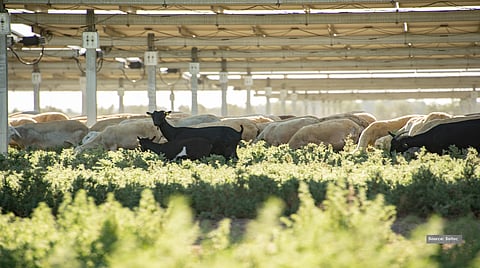


Agrivoltaics is gaining traction due to land-use constraints and evolving permitting requirements
Tracker adaptations such as increased height, wider spacing, and flexible configurations enable coexistence with crops and machinery
Higher material use and system costs are offset by policy incentives and improved project acceptance in key markets
Agrivoltaics is emerging as an interesting application for PV. This is mainly driven by land-use constraints and permitting requirements in several regions. In order for PV systems to coexist with key elements of the agriculture ecosystem, such as crops, grazing, or agricultural machinery, agrivoltaics require elevated structures, wider row spacing, and configurable table heights. Trackers are inherently flexible in these areas. However, while trackers tweaked for agrivoltaics require more steel and result in higher system costs, several tracker suppliers participating in this survey agree that policy incentives in regions such as Europe help offset the premium. As a result, agrivoltaics has become a growing application for tracker systems, particularly in markets where dual-use land strategies accelerate permitting or improve project acceptance.
Sunchaser notes that 2P trackers naturally offer higher mounting heights and wider row spacing, making them the best fit for such applications. The company also provides customized solutions. In one project, according to Sunchaser’s CTO, Chintan Patel, , the company increased the tracker height to accommodate growing elephant grass up to 3 m tall. The modified installation achieved module clearances of about 2.5 m, enabling cattle to move comfortably underneath (see Terrain Adaptation Becomes A Key Solar Tracker Requirement).
Agrivoltaics is an important market segment for Axial, particularly in France and Italy, where dual-use land strategies help streamline permitting. The company has completed 40 MW of Agri-PV installations in France and is now deploying elevated trackers in Italy with module clearance heights ranging from 0.7 m to 2.1 m. These systems allow agricultural machinery to operate beneath the modules. Axial notes that elevated agrivoltaics trackers typically require 3 to 4 times as much steel as standard installations, but government incentives make these solutions economically feasible.
PVH is expanding its product line to address growing demand for Agri-PV solutions, especially in Europe. The company designs tracker systems that support dual land-use and adapts configurations to meet local regulatory, environmental, and agricultural requirements. PVH emphasizes that agrivoltaic systems cannot rely on a single global design template. The company’s solution includes tailored tracker heights, spacing, and structural adaptations to meet region-specific needs.
Soltec has also developed a range of agrivoltaic solutions based on its SF7 platform. The standard agrivoltaic configuration provides approximately 1.3 m of clearance between the lowest module edge and the ground and complies with prevailing German and Italian agrivoltaic standards. For more demanding agricultural applications, the company offers an advanced design with around 2.1 m clearance, enabling the use of larger agricultural machinery beneath the modules (see Tilted Trackers: A Niche Alternative To Conventional Designs).
Beyond mechanical adaptations, Soltec is developing algorithm-based functions to regulate solar exposure for crops. These include operating modes that increase or limit radiation reaching the plants and adjust tracker movement to avoid shading conflicts as crops grow taller. By linking tracker control strategies with crop protection and yield considerations, the company extends agrivoltaics beyond structural elevation toward integrated land-use optimization.
At EU PVSEC 2025, Muñoz et al. (CENER) presented the paper ‘Development and Evaluation of Agrivoltaic Systems in Olive Groves Based on a Novel Smart Tracking Algorithm,’ demonstrating how single-axis trackers can be adapted for agrivoltaic environments through application-aware control strategies. The study integrates crop-specific and environmental parameters into tracker operation, enabling dynamic orientation adjustments that prioritize agricultural needs such as light management and weather protection.
The text is an edited excerpt from TaiyangNews’ Market Survey on Solar Trackers 2026, which can be downloaded for free here.
