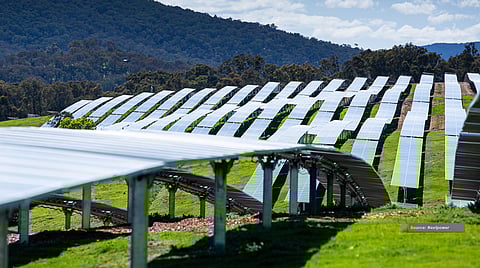


Terrain-following capability has shifted from a niche feature to a standard requirement as projects move to irregular and undulating land
Suppliers differentiate through mechanical approaches such as torque-tube bending, cardan joints, and multi-drive architectures, along with software optimization tools
Reduced grading requirements lower project costs, simplify permitting, and accelerate deployment timelines
Terrain-following tracker design, once considered a specialized feature, has now become a central requirement in modern solar projects.
Several factors are driving this trend. As flat land becomes scarcer and more expensive, solar projects are increasingly assigned to irregular, undulating parcels. Earlier tracker designs typically required significant land grading to achieve uniform installation conditions. But this is no longer an option. Rising earthwork costs increase overall project execution costs. Even more pronounced are the stricter environmental regulations in many countries that restrict or prohibit heavy land modification. “In some markets, even limited earthwork can trigger compliance issues,” says YunHua (Kevin) Shu, Deputy Director of Product Management at TrinaTracker. Therefore, minimizing ground disturbance is not only a cost consideration but also a regulatory requirement. For these reasons, the tracker's terrain-adaptive feature is a key item on the developers' checklist. The feature also accelerates deployment timelines. This push has triggered the segment to derive solutions for terrain adaptability. As a result, several suppliers introduced their terrain-following concepts, resulting in a range of mechanical approaches.
Nextpower reiterates that terrain-following capability has become a mainstream requirement across the tracker industry. Nextpower applies a controlled engineering methodology based on defined slope limits and site-specific design parameters. Adoption depends not only on slope-handling capability but also on operational history, supply-chain stability, and service support.
More solar projects are moving to undulating, hard-to-build sites with a mixture of ground conditions. Terrain-following trackers eliminate or greatly reduce grading, as customers seek to avoid cut-and-fill, reduce steel and concrete, and accelerate permitting. Terrain following trackers can increase terrain conformity, making previously uneconomical land viable, explains Anvitha Ravi, senior manager at the global market intelligence division.
Antaisolar’s solution here is its latest AT-Spark. The platform features dual spherical bearings that rotate universally, allowing the system to automatically adapt to uneven terrain. This eliminates manual torque-tube alignment. The bearings snap into place in a single step, and the flip-top design supports fast assembly and disassembly. A dedicated bracket prevents sagging of the synchronous shaft, ensuring alignment across varying slopes, the company says.
Sunchaser adapts pile lengths to natural topography to support north-south slopes greater than 10°. The company notes that terrain adaptation is more difficult with single-drive systems. Sunchaser relies on a combination of lighter torque tubes and a multi-drive architecture, allowing the system to adapt to terrain to some extent (see Tilted Trackers: A Niche Alternative To Conventional Designs).
TrinaTracker, while acknowledging the importance of terrain-following capability essential for future tracker designs, underscores that it has not finalized its strategy. The company has begun R&D on the subject and has shared its initial analysis of market practices. Some companies use controlled torque-tube bending (such as Nextpower) to adapt to slope variations. According to Shu, while this method works for mild or unidirectional slopes, it may struggle on complex, multidirectional terrain. As an alternative, Trina is evaluating articulated cardan-joint mechanisms, which provide multi-angle adaptability without relying on tube deflection. The company has yet to finalize its choice of architecture.
PVH’s Terrain Response feature allows the torque tube to bend up to 2° between posts, doubling the adjustment range of earlier systems and exceeding the typical 1.5° to 1.7° found on the market, according to Sharma. This capability enables installation on uneven or rocky terrain with minimal grading. PVH additionally emphasizes layout flexibility through its Axone Duo Infinity platform, which supports multiple string configurations and improved terrain adaptability, helping EPCs optimize tracker alignment across uneven sites.
Soltec offers 2 solutions as part of its offering for terrain adaptability. Its standard SFOne tracker can be installed on irregular slopes after a dedicated engineering study and can accommodate around 2% slope (about 1.2°) via tube bending, which is suitable for slightly uneven ground. For more irregular terrain, Soltec has developed the SF4x4 terrain-following tracker, which integrates a cardan joint in the torque tube. This system enables a north-south slope tolerance of up to ±15%, allowing rows to follow uneven terrain without changing the standard piling pattern.
The articulated joint accommodates ±200 mm vertical irregularities and provides around 0.8° of angular flexibility between piles. In typical site conditions, this mechanical adaptability can significantly reduce cut-and-fill requirements, preserving standard SFOne assembly procedures while improving constructability. The design remains compatible with 2 to 3 strings per row, and Soltec offers a topographic modeling tool to compare grading requirements between adaptable and non-adaptable layouts (see Tracker Drive Designs Depend On Cost And Structural Requirements).
Axial’s Slope Sync solution incorporates a cardan joint that provides articulation across both positive and negative slopes, offering ±45° of rotational freedom. Standard pile tolerances of ±100 mm increase to ±200 mm when using Slope Sync, according to Rodolfo Sejas, Business Development Specialist at Axial Structural Solutions. The expanded tolerances reduce the need for precise pile alignment and increase installation speed. Spherical pile supports help minimize vertical-height errors and improve structural stability. The cost premium for the solution remains under 3%, says Sejas, with reduced earthworks and added mechanical capability easily offsetting it.
Zimmermann says that in-house software development and the tight integration of the tracker controller design are core parts of its approach to addressing complex terrain. This has led to the development of software products such as ZIMply Terrain Track, which adjust tracking behavior on undulating sites to reduce inter-row shading. Zimmermann reports that this approach has been verified by DNV, delivering a 2.34% energy gain in an example project.
With time, terrain-following has evolved from a niche capability to a mainstream requirement. Suppliers now differentiate mainly through articulation mechanisms, installation tolerances, and software-enhanced design tools. As grading costs rise and environmental restrictions tighten, terrain-following systems are expected to become standard across utility-scale trackers.
The text is an edited excerpt from TaiyangNews’ Market Survey on Solar Trackers 2026, which can be downloaded for free here.
