

Researchers achieved 24.3% efficiency Cu-metallized TOPCon cells using screen-printed fire-through copper contacts on the rear side
The Cu-contacted cells were only 0.2% absolute behind fully silver-metallized references
Damp-heat and dry-heat tests showed stable performance after 1,000 hours, supporting copper’s reliability potential
Silver reduction remains one of the photovoltaic industry’s most urgent cost-reduction priorities as TOPCon production scales toward multi-terawatt deployment. Copper has long been viewed as the most viable alternative due to its low cost and abundance. However, industrial adoption has remained limited because of Cu diffusion into silicon and associated reliability risks.
A team led by researchers at Georgia Institute of Technology, together with Bert Thin Films and the National Laboratory of the Rockies, has demonstrated 24.3% efficiency in TOPCon solar cells using screen-printed, fire-through copper rear metallization. The approach was enabled by optimized Laser Enhanced Contact Optimization (LECO) processing. The results show that Cu can approach silver-level performance in industrial-style TOPCon cells while maintaining durability.
The researchers applied silver metallization to the front boron emitter and replaced rear-side silver TOPCon contacts with a proprietary screen-printable copper paste. Since Cu diffusion during firing remains a major challenge, the rear copper contact was processed at significantly lower temperatures of 530°C to 535°C, followed by LECO treatment to reduce contact resistance.
Under optimized firing and LECO conditions, the best Cu-contacted TOPCon cell delivered 732 mV Voc, 41.1 mA/cm² Jsc, 80.8% fill factor, and 24.3% efficiency. The silver-metallized reference cell reached 24.5%, leaving only a 0.2% absolute efficiency gap. According to the authors, the voltage and pseudo-fill factor of the Cu-contacted cells were nearly identical to the Ag reference, with most of the remaining loss attributable to higher series resistance.
The study found that Cu contacts exhibited slightly lower metal-induced recombination than silver contacts on TOPCon. Rear-side metallization recombination current density measured 25–45 fA/cm² for Cu, compared to around 60 fA/cm² for Ag. The advantage is primarily attributed to the lower firing temperatures used for Cu processing. However, contact resistivity remained around 10× higher for Cu, at approximately 10 mΩ-cm² vs. 1 mΩ-cm² for Ag, which continues to limit fill factor.
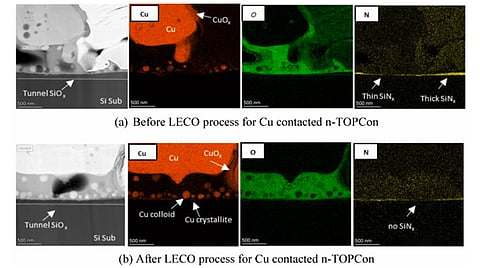
Microscopy analysis suggests the LECO process plays a key role in enabling Cu contact formation. The authors observed that LECO promoted the formation of Cu-rich colloids and crystallites within the poly-Si contact layer while keeping them away from the tunnel oxide. This appears to improve contact conductivity without damaging passivation.
Reliability testing also produced encouraging results. The Cu-metallized cells maintained stable Voc and pseudo-fill factor after 1,000 hours of dry-heat exposure at 200°C, while single-cell mini-modules retained nearly 100% of initial efficiency after 1,000 hours of damp-heat testing at 85°C/85% RH. The authors noted no significant Cu diffusion-related degradation during testing.
The detailed findings have been published on ResearchGate in a paper titled “>24% Screen Printed Cu Contacted n-TOPCon Solar Cells With Successful Implementation of LECO Process.”
The TaiyangNews Market Survey on Solar Cell Production Equipment 2025 identifies metallization as one of the most critical cost and performance levers in TOPCon production. The report notes that TOPCon’s dual-sided silver requirement is intensifying industry efforts toward silver reduction, while laser-assisted metallization is emerging as a key enabler for next-generation contact optimization.
