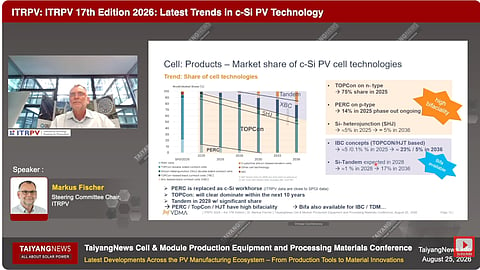


TOPCon is expected to remain the leading cell technology, while TOPCon-based BC could reach a 23% market share by 2036
Tandem module efficiency is forecast to reach 27.4% in 2028 and 31% in 2036
Silver consumption is expected to decline through lower paste use, improved metallization designs and greater adoption of copper
The International Technology Roadmap for Photovoltaics (ITRPV) expects larger and thinner wafers, continued TOPCon dominance, and growing adoption of back-contact (BC) and tandem cell technologies over the next decade.
Presenting the 17th edition of the roadmap at the TaiyangNews Cell & Module Production Equipment and Processing Materials Conference 2026, ITRPV Steering Committee Head Dr. Markus Fischer discussed developments covering wafers, cells, modules, materials, applications, and system costs.
The roadmap is based on contributions from 38 organizations across Asia, Europe, and the US. It covers more than 70 parameters related to PV materials, production processes, products, and systems.
Wafer Trends
Monocrystalline silicon now accounts for almost the entire crystalline silicon wafer market. N-type mono held a share of approximately 82% in 2025 and is expected to remain the mainstream material. P-type mono, which is mainly used for PERC cells, is forecast to decline to around 1.5% by 2036.
Larger wafer formats are also becoming standard. According to Fischer, G12 and rectangular G12R are now the mainstream formats, while M10 is expected to lose market share. Formats larger than G12 could gradually enter the market over the coming years.
Wafer thickness is forecast to decline across the main cell technologies. In 2026, wafer thickness is expected to be around 140 µm for PERC, 130 µm for TOPCon, and 120 µm for heterojunction (HJT). By 2036, TOPCon wafer thickness is forecast to fall to approximately 120 µm, while HJT could reach around 100 µm.
Cell Technology
TOPCon accounted for around 75% of crystalline silicon cell production in 2025 and is expected to remain the leading technology over the next decade. PERC held about 14% and is being phased out. HJT accounted for around 5% and is forecast to maintain a relatively stable share through 2036.
BC technologies are expected to expand substantially. TOPCon-based BC, also known as TBC, is forecast to grow from approximately 5% in 2025 to around 23% in 2036. HJT-based BC could increase from around 0.1% to approximately 5% over the same period.
Silicon-based tandem cells are expected to enter the market in considerable volumes around 2028 and reach a share of approximately 17% by 2036. Perovskite-n-type silicon is forecast to become the principal tandem configuration.
Mass-production cell efficiency is expected to increase from 25.6% for TOPCon, 25.6% for HJT, and 26.1% for TBC in 2026 to 26.4%, 26.7%, and 27%, respectively, in 2036. Single-junction silicon cells are approaching their practical efficiency limit. Tandem cells are expected to move beyond this range, with mass-production efficiency forecast at 28.8% in 2028 and 32.3% in 2036.
Module Technology
At the module level, mass-production efficiency is forecast to increase from 23.9% for TOPCon, 23.9% for HJT, and 24.3% for BC in 2026 to 25.2%, 25.3%, and 25.6%, respectively, in 2036. BC is expected to retain the highest efficiency among the main single-junction module technologies. However, the efficiency differences among TOPCon, HJT, and BC are forecast to narrow.
Tandem modules could provide the next major increase in module efficiency. Their mass-production efficiency is forecast to reach approximately 27.4% in 2028 and 31% in 2036.
Module dimensions are expected to increase. Modules with an area of 1.8 m² to 2 m² will remain the main residential category, while products larger than 3 m² could gain share in power plants. Performance warranties are forecast to increase from 27 years in 2025 to 35 years in 2036. The expected technical lifetime of rooftop modules could reach 40 years by 2035.
Module reliability is expected to improve through lower degradation and longer warranties. Performance warranties are forecast to increase from 27 years in 2025 to 35 years in 2036, while product warranties could increase from 15 to 20 years.
Material Consumption
Lower wafer thickness, reduced kerf loss, and production improvements are expected to reduce polysilicon consumption per watt. For TOPCon products, polysilicon consumption for G12 wafers is forecast to decline from 1.84 g/W in 2026 to 1.39 g/W in 2036. Consumption for G12R could fall from 1.61 g/W to 1.29 g/W, while M10 is expected to decrease from 1.68 g/W to 1.27 g/W.
At the module level, standard bills of materials (BOMs) will continue to account for most of the market. However, specialized material combinations designed for deserts, tropical climates, floating PV, and regions with heavy snow could reach a market share of around 20% by 2036.
Metallization Paste
Silver remains one of the most expensive materials used in solar cell production. For an M10 cell, average silver consumption in 2025 was approximately 70 mg for PERC, 88 mg for TOPCon, 100 mg for HJT, and 104 mg for IBC/TBC.
For TOPCon, average silver consumption was around 10 mg/W. At the silver price used in the presentation, this represented a material cost of approximately $0.02/W. Further reductions are expected through finer metallization patterns, lower paste consumption, and multi-busbar designs. By 2036, silver consumption per M10 cell is forecast to decline to around 57 mg for TOPCon, 40 mg for HJT, and 60 mg for BC.
Copper-based metallization is also expected to gain importance in HJT, BC, and tandem cells. HJT is particularly suited to copper substitution because it uses low-temperature metallization processes. Silver-based HJT metallization is forecast to decline from around 75% of production in 2025 to approximately 10% in 2036. Silver-coated copper and pure-copper technologies are expected to account for most of the remaining production.
Tandem cells could also reduce silver consumption per watt because their higher efficiency generates more power from the same cell area.
PV Applications
Residential rooftop and C&I systems are expected to maintain market shares of approximately 20% and 10%, respectively. Standard power plants will remain the largest application, although their share is forecast to decline from around 60% in 2025 to 46% in 2036.
Specialized applications are expected to grow. Agrivoltaics could increase from approximately 1% of the market in 2025 to 10% in 2036. Building-integrated PV (BIPV) could reach around 8%, while floating PV (FPV) could account for approximately 5%.
The growing share of these applications is expected to increase demand for modules and material combinations designed for specific environmental and installation conditions.
Cost and Outlook
The ITRPV learning curve shows that PV module prices declined by an average of 26% whenever cumulative shipments doubled between 1976 and 2025. Fischer said further cost reductions will depend on combining higher module efficiency with continued reductions in manufacturing cost per module.
The roadmap also expects the levelized cost of electricity (LCOE) from PV to decline further as module efficiency, energy yield, and system lifetime improve. It cited a global benchmark solar LCOE of $0.039/kWh in 2025, which is forecast to fall to $0.027/kWh by 2035.
The roadmap's market findings, including global module shipments of 706 GW in 2025, were covered in an earlier TaiyangNews article (see ITRPV Sees PV Shipments Stabilize At 706 GW In 2025).
Access the full presentation here.
