
Key takeaways:
Fraunhofer ISE demonstrated that Ni/Cu/Ag plating can reduce silver consumption by over 90% in TOPCon cells
Hybrid metallization, combining plating on the rear and screen-printing on the front, currently shows better efficiency and cost balance
Challenges such as contact recombination and adhesion remain, requiring optimization of laser contact opening and interface design
TOPCon, the current mainstream solar cell technology, is inching closer to its theoretical efficiency, while its manufacturing costs have reduced in the last few years. Given that there is still room for improvement, researchers are working on these 2 aspects to make TOPCon more competitive and sustainable in the technology race for a little longer.
From a materials perspective, silver is the key cost driver for any technology, be it TOPCon, heterojunction (HJT), or back contact (BC). There is ongoing research to find an alternative to silver or to reduce its consumption without sacrificing performance (see Metallization Challenges In Advanced TOPCon Cell Development). Combining copper has been the most common solution for reducing silver consumption, typically using silver-coated copper pastes. Research is also underway on electroplating and the usage of copper pastes.
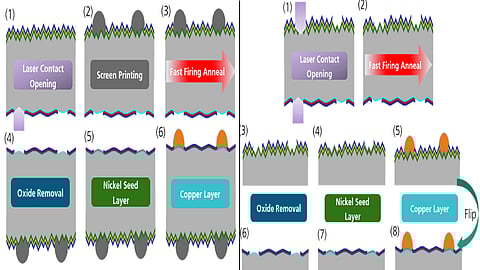
A team at Fraunhofer ISE is studying a plating approach that uses stacked layers of nickel (Ni), copper (Cu), and silver (Ag). Experiments were carried out by plating on both sides of TOPCon with this stack, and plating on the rear side with mainstream screen-printing on the front (hybrid metallization). Inline equipment from RENA Technologies is used for plating to make the process compatible with commercial-scale high-throughput manufacturing. Comparisons of cell performance between double-side plating and hybrid metallization showed that the latter is currently the most economical and offers better performance.
To achieve this plating, the antireflection coating (ARC) and passivation layers are ablated using laser contact opening (LCO). Nickel is first plated as a seed layer of <1 µm, followed by a copper layer of 3-10 µm. At the top, a silver capping layer with a thickness of <0.5 µm is plated. With the plating method, silver consumption was reduced by 93% to only 1 mg/Wp. Hybrid metallization, on the other hand, reduces silver consumption to less than 10 mg/Wp, compared to about 17 mg/Wp with double-sided screen printing.
The experiments were carried out on a batch of 186 TOPCon cells based on M10 wafers. The hybrid-metallized cells achieved efficiencies of up to 24.3%, and the double-side plated ones achieved up to 22.7%. These cells were also made into modules for reliability testing. The Voc of the double-side plated cells is lower due to the recombination losses at the plated contacts on the front side. This is because the area under plated contacts is completely removed by LCO, leaving it unpassivated, unlike mainstream LECO post-treated screen-printed contacts. Mini modules made with these cells were tested for damp heat (DH2000) and showed a power degradation of less than 2.3%.
The study also addressed challenges such as contact adhesion and nickel nucleation. Proper LCO formation is key to achieving this. A complete ablation of the dielectric layers, with no residue on the silicon, enables proper formation of the Ni seed layer. Contact recombination is another area that needs to be addressed. The LCO area needs to be reduced to about 2-3 µm on the front side to a level comparable to mainstream LECO contacts. Using a selective-emitter approach on the front side is another optimized approach identified in this study. The detailed work can be accessed on ResearchGate, under the title Inline Plating of Ni/Cu Contacts for Industrial TOPCon Si Solar Cells—Status and Outlook.

