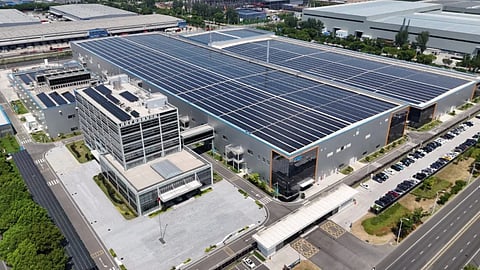


Perovskite solar manufacturer Wuxi UtmoLight Technology has connected a 6.7 MW rooftop distributed PV project in Wuxi, Jiangsu Province, to the grid.
The company said the installation is the world's largest single commercial perovskite rooftop project to date, using around 15,000 self-manufactured 2.81 m² perovskite modules. Operating under a 'self-consumption with excess to grid' model, the project is expected to generate more than 6.56 million kWh of electricity annually.
Beyond rooftop installations, UtmoLight also deployed perovskite modules across 13,240 m² of curtain walls, corridors and other building surfaces within the industrial park. According to the company, the integrated system has achieved an overall energy-saving rate of 86.18%.
Last month, UtmoLight released results from a 172-day field test of its 2.81 m² perovskite modules, installed at a project that was connected to the grid in January 2026 (see China Solar PV News Snippets).
China has released the 'National 15th Five-Year Plan for Addressing Climate Change,' outlining measures to accelerate the development of a new energy system, expand renewable energy deployment and increase green electricity use.
The plan targets a 17% reduction in CO2 emissions per unit of GDP by 2030 compared with 2025 levels while advancing a dual-control system covering both total carbon emissions and carbon intensity.
It also promotes Green Electricity Certificates (GECs), zero-carbon factories and industrial parks, and renewable energy substitution. In addition, the plan calls for improving carbon footprint management through a national database, product labeling and certification, and closer alignment with international standards.
China’s roadmap targets more than 2.8 TW AC of combined wind and solar capacity by 2030 (see China Targets 2.8 TW AC Solar & Wind In 15th Five-Year Plan).
China Energy Engineering Corporation Limited (Energy China) has commenced full-scale operation of the first phase of its Shapotou livestock-PV-storage project.
The project comprises 400 MW AC (508.13 MW DC) of solar capacity and a 220 MW/880 MWh independent energy storage system (ESS). It also features an integrated monitoring platform coordinating PV generation, energy storage, and synchronous condensers for centralized plant operation.
The project is expected to generate 924 million kWh of electricity annually while supporting livestock grazing beneath the solar arrays, demonstrating the integration of renewable energy generation with pasture development.
Earlier this year, Energy China started construction on a 900 MW solar thermal and PV project in Damxung County, Lhasa, Tibet (see China Solar PV News Snippets).
TCL Solar and Yingli Solar have won a 429 MW TOPCon module procurement tender issued by GD Power for the second phase of the 1 GW Haijing salt-solar complementary project in Tianjin.
The tender covers n-type TOPCon bifacial double-glass modules with a minimum output of 590 W. TCL Solar secured the first and third sections totaling 289 MW with bid prices of RMB 0.728/W and RMB 0.731/W, while Yingli Solar won the remaining 140 MW section with a bid price of RMB 0.745/W.
China's National Energy Administration (NEA) has released its '2026 China New Energy Storage Development Report,' showing cumulative installed new energy storage capacity reached 136 GW/351 GWh by the end of 2025, up 84.3% year-over-year.
Average storage duration increased to 2.58 hours, while average annual utilization reached 1,195 hours and 256 equivalent charge-discharge cycles. The report said new energy storage enabled the utilization of more than 30 billion kWh of renewable electricity, improving renewable energy utilization by around 2 percentage points.
Lithium-ion batteries accounted for about 96.1% of installed capacity, while compressed air and flow battery technologies continued to develop. Looking ahead, the NEA said it will continue improving policies, technical standards and innovation to support the sector during the 15th Five-Year Plan period (2026-2030).
