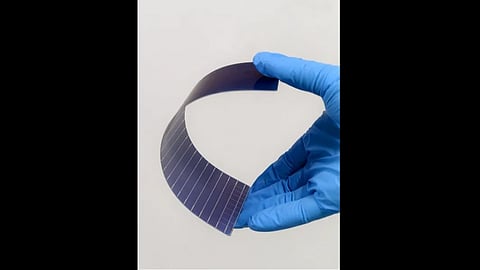


Solar module manufacturer GCL SI has achieved a certified conversion efficiency of 33.44% for its self-developed flexible perovskite-silicon tandem solar cell, verified by the China National Center of Inspection on Solar Photovoltaic Products Quality (CPVT).
Developed jointly with Soochow University, the cell also achieved a device-level power-to-weight ratio exceeding 2,000 W/kg. The company stated that the research team developed lightweight, bendable cells that resist fracture by overcoming challenges in ultra-thin silicon substrate integration, interface passivation, and flexible stress control.
GCL SI said the technology is suitable for aerospace applications including satellites, space stations, and deep-space exploration. The team is now focusing on improving long-term stability and scaling up large-area manufacturing to support commercialization.
In May, GCL SI revealed its plans to convert a 7 GW TOPCon module production line in Funing County, Yancheng, Jiangsu Province, to back-contact (BC) technology (see China Solar PV News Snippets).
An increasing number of companies have been exploring the perovskite tandem architecture and reporting record efficiencies. Recently, LONGi announced that its independently developed crystalline silicon-perovskite tandem solar cell achieved 35.5% efficiency (see LONGi Unveils ‘Technology Forest’ With 8 Core Technologies).
Battery technology company Envision AESC has commenced Phase I operations of its intelligent lithium battery facility in Yichang, Hubei Province, producing the first batch of 790 Ah energy storage cells.
The facility covers key segments of the lithium battery value chain, including electrode production, cell manufacturing and battery pack assembly. Phase I includes 40 GWh of energy storage cell capacity, while the planned Phase II will add 60 GWh of cell capacity and 60 GWh of energy storage system (ESS) capacity. According to local media, construction of Phase II began in April 2026.
Once fully operational, the project is expected to become the world's first integrated 100 GWh-scale energy storage industrial base.
China's National Development and Reform Commission (NDRC), Ministry of Natural Resources, and Ministry of Water Resources have jointly issued an action plan for the seawater desalination industry. The plan targets total desalination capacity of more than 4.5 million tonnes per day by 2030, including over 1.5 million tonnes per day of new capacity.
The plan calls for greater use of clean energy in seawater desalination, including solar, wind and marine energy, while promoting the development and demonstration of renewable energy coupling and solar thermal technologies. It also encourages coastal provinces and cities to introduce policies that enable eligible desalination projects to use locally generated renewable electricity.
A 1 GW renewable energy base in Chifeng, Inner Mongolia, has been connected to the grid.
Developed by a joint venture between Chifeng State-owned Capital Operation Group and Guolong Energy, the RMB 4.5 billion project comprises 850 MW of wind power, 150 MW of solar PV, and a 150 MW/300 MWh ESS.
The project is part of China's third batch of ‘Desert, Gobi and Wasteland’ renewable energy base projects and combines renewable power generation with ecological restoration efforts in desertified areas.
BC cell and module manufacturer AIKO expects to report an adjusted net loss of RMB 7.7 billion to RMB 8.8 billion for the first half of 2026, compared with an adjusted net loss of RMB 4.24 billion in the same period of 2025.
The company said ABC module sales revenue continued to grow during the reporting period, with overseas sales accounting for a larger share and module gross margins improving both year-on-year and quarter-on-quarter. However, profitability remained under pressure due to continued supply-demand imbalance across the PV industry, delayed end-market price adjustments, the cancellation of export tax rebates for PV products, foreign exchange fluctuations and asset impairment provisions.
Recently, AIKO secured a contract to supply 677.99 MW of modules for Section II of Zhejiang Provincial Energy Group's 1.2 GW solar power base (see China Solar PV News Snippets).
