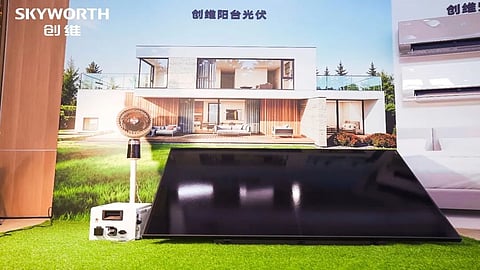


SKYWORTH Solar has unveiled a third-party-financed commercial and industrial (C&I) solar solution at the 2026 product launch event of its parent company, Skyworth Group. Under the model, businesses provide unused rooftop space while SKYWORTH Solar finances, builds, operates, and maintains the PV system.
The solution targets manufacturing facilities, industrial parks, logistics and warehousing sites, and commercial complexes. According to the company, participating businesses can purchase electricity from the system for as little as RMB 0.30/kWh. Ownership of the power plant will be transferred to the customer at no cost upon expiration of the agreement.
The company also introduced a balcony PV system that combines PV modules, an inverter, and battery storage in a plug-and-play design. The system is available in different capacities to match household electricity demand.
SKYWORTH Solar recently started construction on a 300 MW/600 MWh standalone energy storage power station in the Jinzhong Development Zone of Shanxi Province (see China Solar PV News Snippets).
China added 158.70 GW AC of new power generation capacity in H1 2026, according to data from the National Energy Administration (NEA). Solar accounted for 72.07 GW, down 66% year-over-year, while new wind installations reached 38.62 GW, down 25%.
The decline largely reflects a high comparison base in 2025, when developers rushed to complete projects before the introduction of market-based pricing for new renewable energy projects after May 31, 2025. That pushed China’s full-year solar additions to around 317 GW and wind additions to 120 GW, both record highs. With that demand brought forward, project development and grid connection activity returned to a more normal pace in H1 2026.
At the end of June, China’s total installed power generation capacity reached 4.04 TW. Solar capacity stood at 1.274 TW, accounting for 31.5% of the total, while wind capacity reached 678.75 GW, representing 16.8%. Combined wind and solar capacity accounted for 48.3% of the national power generation fleet.
Wind and solar are expected to play a leading role in China’s next phase of economic and energy transition under its 15th Five-Year Plan (2026-2030) (see China Targets 2.8 TW AC Solar & Wind In 15th Five-Year Plan).
Leading PV manufacturer JA (previously JA Solar) plans to upgrade two module production lines in Yangzhou, Jiangsu Province. According to a local government disclosure, the projects involve a total investment of RMB 210 million and include a perovskite tandem module pilot line and a conventional module production line.
The first of the two projects will convert an existing 72-cell module production line into a 600 MW perovskite tandem module pilot line, replacing an equivalent amount of conventional module capacity.
The second project will upgrade 14 existing 54-cell and 72-cell module production lines into 10 production lines for 66-cell modules. The upgrade will shift production from monofacial to bifacial modules, with module power increasing from 425 W/570 W to 650 W.
On the earnings side, JA expects its adjusted net loss to widen in H1 2026 (see China Solar PV News Snippets).
PV encapsulation material supplier Hangzhou First expects to report an adjusted net profit of RMB 751.94 million for the first half of 2026, up 67.53% year-over-year.
The company attributed the increase in part to higher selling prices for PV encapsulation films, driven by rising costs of PV resin raw materials amid geopolitical tensions in the Middle East. Higher sales volumes and improved profitability of photosensitive dry film products used in PCB manufacturing also contributed to earnings.
