

Energy storage emerged as a key topic, partly driven by the growing power requirements of AI data centers
Next-generation TOPCon, BC technology, multi-cut cells, and application-specific modules were among the major PV trends
Cable-based mounting, module recycling, and integrated home energy ecosystems represent emerging industry opportunities
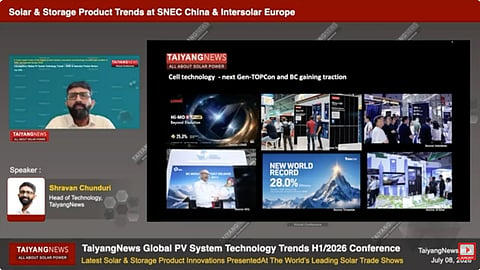
TaiyangNews held a two-day virtual conference on July 8 & 15, 2026, to review the key technologies and products presented at SNEC PV and Intersolar Europe 2026. During the conference, Shravan Chunduri, Head of Technology at TaiyangNews, provided an overview of the company’s observations from the two exhibitions.
On the solar PV side, Chunduri noted that TOPCon remained the mainstream cell technology, with next-generation products featuring rear poly-fingers and edge passivation entering the commercial market. Back-contact (BC) technology is also gaining traction, with new product introductions from companies such as JA, Trinasolar, and GCL SI. Equipment manufacturers are closely following these developments, preparing production platforms to support next-generation TOPCon and BC technologies while also looking ahead to perovskite and tandem cells.
At the module level, multi-cut cells and high-density layouts are increasingly being used together. One-third- and quarter-cut cell formats help reduce electrical losses, while zero-gap and overlapping layouts allow manufacturers to fit more active cell area into the same module dimensions. Thin polymer films in overlap regions are being introduced to control mechanical stress and reduce the risk of cell cracking. The result is higher module power without a corresponding increase in size. In manufacturing, production equipment is being adapted for multi-cut cells, zero-busbar (0BB) interconnection, and specialized products such as flexible, BIPV, and agrivoltaic modules. At the same time, recycling is emerging as a new opportunity for equipment suppliers, with systems designed to recover materials directly from decommissioned modules
A clear trend was the rise of application-specific modules with optimized BOMs. Module makers are increasingly developing products for dusty environments, deserts, marine locations, vertical installations, buildings, and weight-constrained rooftops. Anti-glare, colored, and lightweight modules are becoming more widely available.
Although not a broad trend, a few companies are focusing on 2,000 V modules, increasing the maximum system voltage from 1,500 V. The benefit is, obviously, that it reduces balance-of-system (BOS) costs, achieved through optimized module design and improved laminate packing using a high water vapor transmission rate (WVTR)-resistant encapsulant and a PIB edge sealant. Smart modules with integrated electronics represent another emerging direction (see Huasun Debuts Himalaya PLUS HJT Modules In Europe).
One of the most interesting innovations is the emergence of cable-based mounting solutions. Here, the modules are suspended from cables rather than installed on racks. While such systems were already seen at SNEC last year, a greater number of companies are entering this segment. The approach is opening new possibilities for mountain PV, agrivoltaics, parking structures, and sites where extensive land grading would be difficult or undesirable. Early solutions are also beginning to incorporate tracking functionality into these cable-based mounting systems rather than simply shredding them (see Oriental FlexTech Showcases Cable-Supported Mounting Solutions).
A key topic to emerge from these shows was energy storage, said Chunduri. Storage innovation was strongly influenced by the rapidly growing power requirements of AI data centers. Suppliers presented systems designed to handle both short-duration power fluctuations and longer-duration energy shifting, including high-rate battery systems and products offering up to 8 hours of storage. Solid-state transformers are also gaining momentum because they combine voltage transformation and power conversion in a digitally controlled platform, potentially simplifying data-center power architecture (see Sungrow Promotes 8-Hour C&I Hybrid Storage System At SNEC 2026).
At the residential level, the industry is moving toward an intelligent home energy ecosystem that integrates rooftop PV, storage, electric vehicles (EVs), heat pumps, air conditioning, and energy management. Energy management systems (EMS) increasingly support real-time monitoring, backup power, tariff arbitrage, and participation in virtual power plants (VPPs). Bidirectional EV charging is becoming an integral part of this ecosystem, enabling vehicle-to-home and vehicle-to-grid applications (see Sungrow Renewables On The Future Of Smart PV Modules).
The growing involvement of major home-appliance manufacturers further suggests that residential energy management is moving closer to the mainstream consumer market. In Europe, plug-in balcony PV combined with modular storage is also gaining popularity, typically designed around the 800 W feed-in limit and supported by integrated energy controls.
