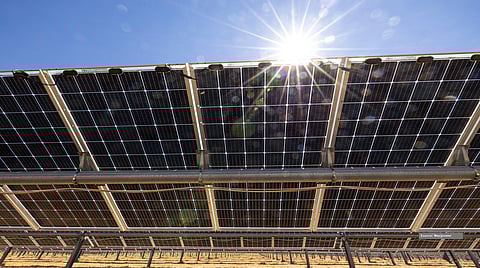


Bifacial modules are now standard in utility-scale projects, with tracker designs already optimized to minimize rear-side shading
Incremental gains depend increasingly on site-specific factors such as albedo, diffuse light, and shading conditions
Market interest in bifacial optimization varies, with stronger emphasis in regions where LCOE gains justify additional focus
Building on the key trends discussed in the previous sections, a few additional developments are worth noting. While these are not as prominent, they continue to shape tracker performance and system optimization. Historically, developments in both trackers and module bifaciality went hand in hand, as both technologies relied on each other during the initial days. Today, bifacial modules have become standard in most utility-scale solar projects, and tracker designs have been optimized for rear-side sunlight absorption. The initial discussion regarding trackers’ compatibility with bifacial panels focused mainly on shading of the torque tube and module height. The field data and simulation results from various sources indicate that the current tracker designs cause minimal rear-side obstruction (see Agrivoltaics Expands In Solar Tracker Deployments).
Trackers are also increasingly becoming smarter to enhance diffuse-light absorption, a relevant feature for bifacial optimization. Research presented at EU PVSEC 2025 by Keith R. McIntosh et al. in the paper “Bifacial and Mismatch Factors of Agri- Photovoltaics Systems” evaluated tracker-based Agri-PV configurations using ray-tracing and circuit-level simulations. While single-axis trackers achieved the highest overall annual energy yield, bifacial gains were limited to around 4% due to greenhouse structures and crop-related shading, though gains reached up to ~13% under overcast conditions. The study further showed that bifacial gain and mismatch losses vary strongly with solar position and diffuse irradiance. Thus, optimizing bifacial performance today depends on more site-specific factors, such as albedo and ground treatment, rather than on tracker geometry alone (see Terrain Adaptation Becomes A Key Solar Tracker Requirement).
On the other hand, customer interest in explicit bifacial optimization varies globally. In regions with low module costs, developers often prioritize CapEx and environmental permits over bifacial gains. In contrast, markets with higher module prices, such as the US and India, bifacial gains continue to retain their prominence given their contribution to LCOE. In the end, the majority of suppliers agree that bifacial performance remains an important differentiator in certain project contexts, even though it has become a baseline feature across the tracker industry.
The text is an edited excerpt from TaiyangNews’ Market Survey on Solar Trackers 2026, which can be downloaded for free here.
