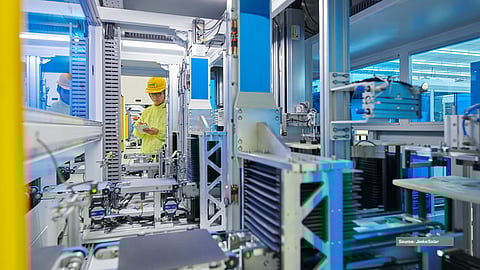


Equipment suppliers have significantly optimized throughput, yield, uptime, and material efficiency, helping reduce CapEx and OpEx amid industry overcapacity
The survey focuses primarily on TOPCon manufacturing, while also covering relevant developments in HJT and back-contact equipment across 5 core process steps
Based on inputs from 14 equipment suppliers and covering 81 products, the survey provides detailed insights into mainstream production tools
The developments in the solar cell production equipment segment are commendable. They have seen optimization in several areas, including throughput, material consumption, yield, and uptime. All these improvements help reduce costs, both CapEx and OpEx, with the former being the most significant one, especially given the ongoing overcapacity situation in the industry. The equipment supply wing has also been very supportive, first with the industry’s shift from PERC to TOPCon, and then with the addition of 2 more technologies – back contact and HJT – to mass production. However, this year’s edition of TaiyangNews Cell Production Equipment Survey 2025 reflects the developments in the production equipment arm of PV, focusing primarily on TOPCon, while also covering updates on HJT and BC equipment where relevant and available.
The survey explores 5 core process categories in solar cell production: surface preparation, emitter formation, passivation, metallization, and IV testing. In addition to discussing the key developments on the equipment side for each of these processing steps, the survey also includes detailed specifications tables . Strictly focusing on the products featured in these tables, this survey is mainly based on responses from 14 different production tool suppliers, which provided data for a total of 81 products.
Within the surface preparation step, mainly accomplished with wet-benches, the survey covers a wide variety of applications, including saw damage etching (SDE), texturing, doped glass removal, edge isolation, rear side polishing, and polysilicon wraparound etching. Texturing for TOPCon continues to evolve with the incorporation of proprietary chemical additives designed to enhance the pyramid structure and reduce reflectivity. All leading wet-benches suppliers are tweaking the process flow and are offering customized solutions for BC processing. Water waste management is now part of the agenda of leading tool suppliers, and solutions are also attracting the attention of end customers (see Texturing - A Key Surface Preparation Step In Solar Cell Manufacturing).
As to the etching tools, to remove undesired layers – BSG, PSG, edge and edge isolation – cluster systems combining batch and inline tools are available in addition to the fully inline configuration. Companies are also tailoring the solutions according to the method of deposition employed for TOPCon core layers.
In junction formation, diffusion plays a key role, with boron diffusion used in TOPCon. The changes related to emitter formation have occurred over a short period. The industry was evaluating selective emitters 2 years ago, which have now become mainstream. And with the industry adopting laser-assisted metallization, it is marching back toward blanket emitters with ultra-high sheet resistance; the survey mentions 300 and 500 Ω/square (see Developments In Diffusion Furnaces For Emitter Formation).
Passivation is the defining element of high-efficiency architectures. For TOPCon, this involves the formation of a tunneling oxide and subsequent polycrystalline silicon deposition, followed by doping. LPCVD and PECVD are the dominant technologies here. LPCVD systems are offered with different integration levels for tunnel oxide and doping, whereas PECVD tools typically handle all steps in one chamber. Now, PVD, with several inherent benefits, including reduced safety and facility requirements, is also extensively promoted here. Another interesting subject in the field of passivation is the passivation of edges originating from laser slicing of fully processed cells into 2, but not limited to (see Passivation – A Key Differentiator Across Solar Cell Technologies).
A critical focus area, particularly for TOPCon’s dual-sided silver requirement, is metallization. A somewhat revolutionary development, not just limited to metallization but also for the overall uptake of TOPCon, is laser-assisted metallization. In addition to benefiting metallization through paste formulation optimization, reducing finger width, and silver saving, this technology also decouples emitter formation from metallization. The survey, in addition to screen printing, the mainstream equipment required for metallization, also discusses the details of paste optimization (see Laser-Assisted Metallization Advances For TOPCon Solar Cells).
IV testing serves as the final validation step in cell production lines, where LED-based testers are gaining popularity due to their superior spectral tuning and stability – particularly beneficial for tandem cells with high capacitance and spectral sensitivity. The survey features tools capable of handling full and half-cut cells with high throughput, as well as support for bifacial and advanced characterization (see IV Testing Systems For Solar Cell Characterization).
We also discussed about ancillary products , such as lasers and characterization tools, along with the latest deposition tools promoted for perovskites. However, the products featured in this section are not accompanied by tables, as the focus is on core products for mainstream cell manufacturing (see Spatial ALD For Perovskite Solar Cell Manufacturing).
The text is an executive summary part from TaiyangNews’ latest Market Survey on Solar Cell Production Equipment 2025, which can be downloaded for free here.
